
Large residential properties face unique thermal challenges that standard residential systems simply cannot address. A home exceeding 4,000 square feet often experiences significant temperature variance between floors and wings, leading to inconsistent comfort and higher energy bills. According to the U.S. Department of Energy, proper zoning and system sizing can reduce cooling costs by up to 30% in larger homes. This guide explores the most effective cooling strategies for expansive properties, ensuring every room remains comfortable without wasting energy.
Why Large Homes Need Specialized Cooling
Standard single-zone air conditioning units are designed for uniform floor plans. In large properties, heat gain varies drastically based on sun exposure, ceiling height, and occupancy. A living room with floor-to-ceiling windows will absorb significantly more heat than a basement bedroom. Without a specialized approach, the system will either overcool some areas while leaving others warm or cycle on and off inefficiently.
Effective cooling begins with understanding the thermal load of your specific property. Factors such as insulation quality, window orientation, and even the number of occupants contribute to the total British Thermal Unit (BTU) requirement. Apex Clean Air specializes in diagnosing these complex loads for homes in Utah, Colorado, and Idaho. We ensure that the cooling solution matches the architectural reality of your home.
Multi-Zone HVAC Systems Explained
Multi-zone systems are the gold standard for large residential properties. They allow you to divide your home into distinct thermal zones, each with independent temperature control. This means you can keep the upstairs bedrooms at 68 degrees while the main living area remains at 72 degrees.
How Zoning Works
Zoning relies on motorized dampers within the ductwork. These dampers open or close based on the thermostat signals from each zone. When a zone reaches its set temperature, the dampers close, redirecting airflow to zones that still require cooling. This prevents the system from fighting against itself and reduces wear on the compressor.
Benefits for Expansive Layouts
For homes with multiple stories or detached wings, zoning eliminates the "hot upstairs, cold downstairs" problem. It also allows for energy savings by not conditioning unused rooms. If a guest wing is rarely used, you can set it to a higher temperature or turn it off entirely. This level of control is impossible with a single thermostat. Learn more about our AC Installation Services to see how zoning can be integrated into your new system.
Ductless Mini-Split Advantages
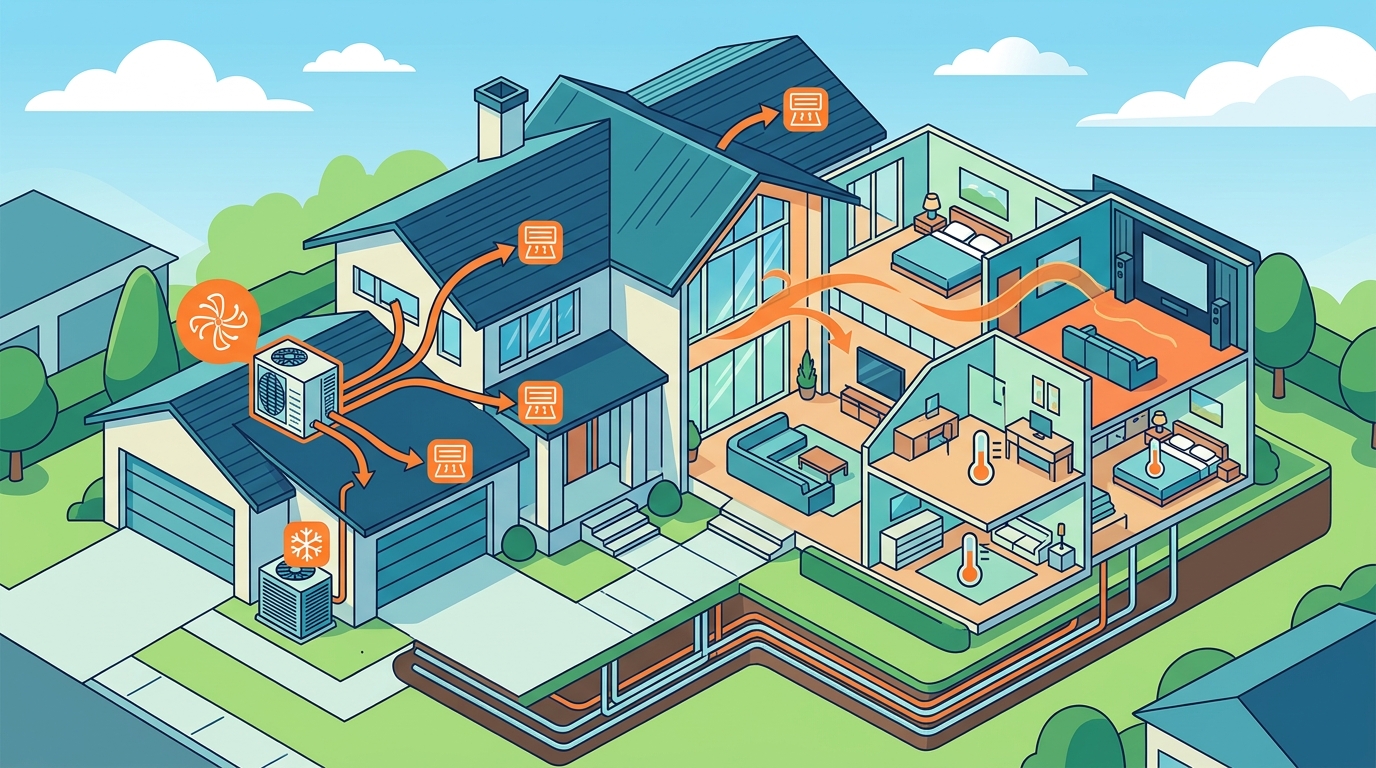
Ductless mini-split systems offer a highly efficient alternative for large homes, particularly those with additions or rooms where extending ductwork is impractical. These systems consist of an outdoor compressor connected to one or more indoor air handlers.
Targeted Cooling
Mini-splits are ideal for targeting specific problem areas. If your master suite is consistently too warm, a dedicated mini-split can solve the issue without overhauling the entire central system. This targeted approach minimizes energy waste because you are only cooling the space that needs it.
Installation Flexibility
Because they do not rely on extensive ductwork, mini-splits can be installed in homes where ducts are leaky or nonexistent. This makes them a popular choice for retrofitting older large homes. Our team provides expert Heat Pump Installation services that can include ductless options for maximum flexibility. For more details on maintaining these systems, review our AC Maintenance Services.
Central AC vs. Heat Pumps
Choosing between a traditional central air conditioner and a heat pump is a critical decision for large properties. Both systems can be effective, but they operate differently and have distinct advantages depending on your climate and energy goals.
| Feature | Central Air Conditioner | Heat Pump |
|---|---|---|
| Primary Function | Cooling only | Heating and Cooling |
| Efficiency | High SEER ratings available | Extremely high efficiency (HSPF) |
| Climate Suitability | Hot, dry climates | Moderate to cold climates |
| Cost | Lower upfront cost | Higher upfront, lower operating cost |
Heat pumps are particularly effective for large homes because they move heat rather than generate it. This process is inherently more energy-efficient. In moderate climates, a heat pump can provide both heating and cooling for the entire year. For homes in colder regions, a hybrid system that pairs a heat pump with a gas furnace may be the most reliable option. Explore our Heating Services to understand how hybrid systems work.
Air Quality Integration
Cooling is only half the equation. Large homes often have stagnant air pockets where pollutants, dust, and allergens accumulate. Effective cooling solutions must include robust indoor air quality (IAQ) management. Poor air quality can lead to health issues and make the air feel warmer than it actually is due to humidity retention.
Whole-Home Air Purification
Integrating air purifiers into your HVAC system ensures that every breath of cooled air is filtered. High-efficiency particulate air (HEPA) filters can capture microscopic particles that standard filters miss. This is especially important for large homes with multiple occupants or pets. Our Air Purification Services help you select the right filtration level for your family's needs.
Humidity Control
Dehumidifiers play a crucial role in cooling efficiency. When humidity is high, your AC must work harder to remove moisture, leading to longer run times and higher bills. Proper humidity control makes the air feel cooler, allowing you to set the thermostat higher without sacrificing comfort. We also offer Air Duct Cleaning Services to ensure that your ductwork does not become a source of contamination.
Key Takeaways
- Zoning is Essential: Multi-zone systems allow independent temperature control, preventing energy waste in unused areas of large homes.
- Ductless Options: Mini-split systems provide targeted cooling and are ideal for additions or homes with inefficient ductwork.
- Heat Pump Efficiency: Heat pumps offer superior energy efficiency for both heating and cooling, especially in moderate climates.
- IAQ Matters: Integrating air purification and humidity control enhances comfort and reduces the load on your cooling system.
- Professional Sizing: Manual J load calculations are required to correctly size systems for large properties, avoiding short-cycling and inefficiency.
- Maintenance is Critical: Regular AC Maintenance Services ensure that large systems continue to operate at peak efficiency over time.
- Local Expertise: Apex Clean Air serves Utah, Colorado, and Idaho, providing tailored solutions for regional climate challenges.
Frequently Asked Questions
How many tons of AC do I need for a large home?
The required tonnage depends on the square footage, insulation, and window orientation. A general rule is one ton per 400-600 square feet, but a Manual J calculation is necessary for accuracy. Contact us for a precise Cooling Diagnostic Services assessment.
Can I install a zoning system in an existing home?
Yes, zoning can be retrofitted into most existing ductwork systems. It involves installing motorized dampers and additional thermostats. Our team can evaluate your current ductwork for Air Duct Cleaning Services and zoning compatibility.
What is the difference between a heat pump and a central AC?
A central AC only cools, while a heat pump provides both heating and cooling by moving heat rather than generating it. Heat pumps are generally more energy-efficient.
How does humidity affect cooling efficiency?
High humidity makes air feel warmer, forcing your AC to run longer. Proper dehumidification improves comfort and reduces energy costs. We offer Indoor Air Quality Testing to measure your home's humidity levels.
Are ductless mini-splits noisy?
Modern mini-splits are designed to operate quietly, often below 40 decibels. They are ideal for bedrooms and living areas where silence is important.
How often should I service a large HVAC system?
Bi-annual maintenance is recommended. Spring for cooling and fall for heating. Regular AC Maintenance Services prevent costly breakdowns and extend system life.
What financing options are available for large installations?
Apex Clean Air offers flexible financing plans to make large HVAC installations affordable. Visit our Financing page for details.
Schedule Your Cooling Consultation
Large residential properties require precise engineering to stay cool and efficient. Do not settle for uneven temperatures or high energy bills. Apex Clean Air provides expert AC Installation Services, Heat Pump Installation, and Air Purification Services tailored to your home's unique needs. Contact your local office in Salt Lake City, Boise, Denver, or Colorado Springs today to schedule a diagnostic consultation and discover the best cooling solution for your family.