

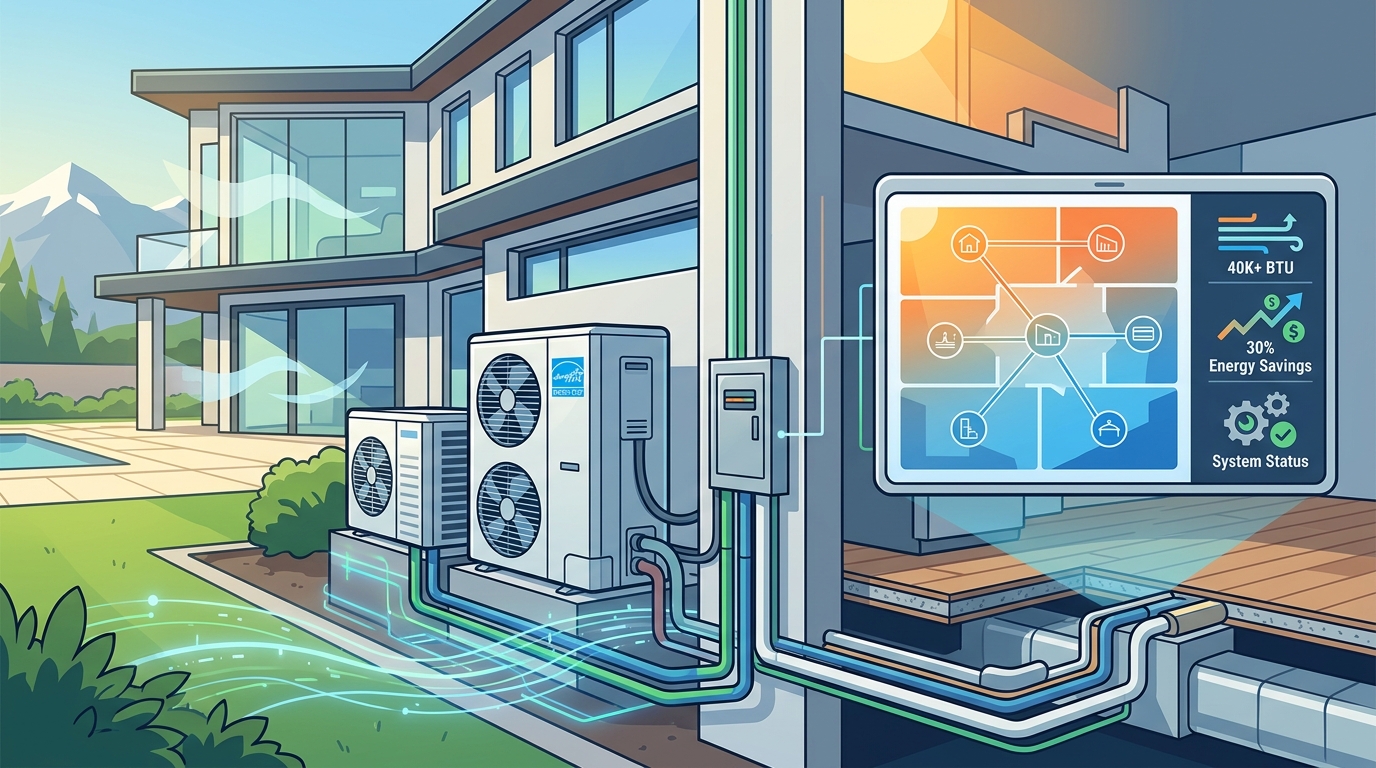
According to recent industry reports, modern large residential properties require an average cooling capacity exceeding forty thousand BTUs to maintain consistent thermal comfort across expansive square footage. Data shows that inefficient climate control in homes over five thousand square feet can increase annual energy expenditure by nearly thirty percent. Homeowners must prioritize scalable infrastructure to prevent system strain and ensure reliable performance during peak summer months. Energy Star ratings provide the foundational benchmark for evaluating these high-capacity systems. Selecting the correct equipment prevents premature compressor failure and eliminates uncomfortable temperature fluctuations throughout the living space.
Understanding Multi-Zone Climate Control Architecture
Large residential properties demand precise thermal management across distinct living areas. A multi-zone HVAC system is a centralized climate control network that divides a single building into independent temperature-regulated sections. This architectural approach eliminates the common problem of overheated bedrooms while keeping living rooms comfortably cool. Homeowners benefit from customized airflow delivery that matches the unique thermal load of each room. Heat pump installation specialists frequently recommend this configuration for expansive floor plans. The primary implication involves reduced energy waste, as unoccupied zones automatically enter standby mode. This targeted delivery mechanism directly correlates with lower utility bills and extended equipment lifespan.
Zone Diverter Valve Mechanics
Diverter valves regulate refrigerant flow to specific indoor air handlers. These mechanical components operate silently and adjust airflow volume based on real-time thermostat demands. Property managers utilize these valves to balance pressure across long duct runs. The result is consistent air pressure without excessive blower noise. ASHRAE guidelines confirm that properly balanced zones reduce compressor cycling by nearly twenty percent. This mechanical efficiency translates directly into quieter operation and fewer mechanical failures.
Evaluating High-Efficiency Heat Pump Deployments
Modern heat pump technology has revolutionized large home cooling strategies. A residential heat pump is a dual-function climate system that extracts ambient thermal energy from outdoor air to cool interior spaces. These units operate with remarkable efficiency even during extreme summer temperatures. Large properties require commercial-grade compressors to handle the increased refrigerant volume. AC installation services providers now prioritize inverter-driven compressors for maximum capacity scaling. The implication of this technology is a drastically reduced carbon footprint without sacrificing cooling power. Homeowners gain year-round comfort while maintaining strict environmental compliance standards.
Variable Speed Compressor Technology
Variable speed compressors adjust their rotational frequency to match exact cooling demands. Unlike traditional on-off cycling, these motors modulate output continuously to maintain precise temperature setpoints. Large residential properties experience fewer temperature swings and significantly lower humidity levels. EPA data confirms that variable speed systems reduce indoor pollutant concentration by filtering air more frequently. This continuous filtration cycle directly improves respiratory health for large families. The technology eliminates the drafty conditions commonly associated with older cooling infrastructure.
Implementing Advanced Air Distribution Networks
Expansive floor plans require sophisticated ductwork engineering to prevent thermal loss. An air distribution network is a sealed ventilation framework that transports conditioned air from central units to every occupied room. Large properties often suffer from uneven airflow due to long duct runs and multiple elevation changes. Air duct cleaning services technicians frequently discover blocked return vents that severely restrict airflow. The implication of proper duct engineering is uniform temperature distribution across all living spaces. Homeowners experience consistent comfort without relying on supplemental space heaters or window units. Comfort Club maintenance programs ensure these networks remain leak-free and optimally balanced.
Static Pressure Optimization
Static pressure optimization measures the resistance air encounters while traveling through ventilation pathways. High resistance forces blowers to work harder, increasing electricity consumption and mechanical wear. Large residential properties require specialized airflow calculations to determine the exact blower motor size. Energy Star ratings mandate strict static pressure limits to qualify for premium efficiency tiers. Engineers address these constraints by installing larger diameter ducts and reducing sharp directional turns. This engineering precision prevents noisy airflow and eliminates cold spots in distant bedrooms.
Integrating Smart Thermostat Automation Protocols
Advanced automation protocols transform traditional cooling systems into responsive climate networks. A smart thermostat is a programmable digital interface that learns occupancy patterns and adjusts cooling output accordingly. Large residential properties benefit from geofencing capabilities that automatically lower cooling output when the house is empty. About Us documentation highlights how certified technicians integrate these devices into existing infrastructure. The implication of smart automation is drastically reduced energy consumption without sacrificing comfort. Homeowners gain remote monitoring capabilities that prevent system failures before they occur. Department of Energy data shows that smart scheduling reduces annual cooling costs by nearly twenty-five percent. This financial benefit compounds significantly over the lifespan of large residential properties.
Occupancy-Based Learning Algorithms
Occupancy-based learning algorithms track daily movement patterns to predict cooling requirements. These digital systems adjust setpoints automatically based on historical usage data. Large properties experience fewer manual adjustments and more consistent indoor temperatures. ASHRAE guidelines recommend integrating occupancy sensors into multi-zone networks for maximum efficiency. The technology eliminates wasted cooling in rarely used guest suites or home offices. Homeowners enjoy seamless automation that adapts to seasonal schedule changes without manual reprogramming.
Scheduling Preventative Maintenance Regimens
Large residential cooling systems require rigorous maintenance schedules to prevent catastrophic failures. A preventative maintenance regimen is a structured inspection protocol that verifies refrigerant levels, electrical connections, and mechanical wear. Large properties experience higher operational stress, making routine checks absolutely essential. Comfort Club subscribers receive priority scheduling and discounted parts during peak summer months. The implication of consistent maintenance is extended equipment lifespan and reliable performance during heatwaves. Homeowners avoid emergency repair costs by addressing minor refrigerant leaks before they cause compressor failure. EPA data confirms that properly maintained systems operate at peak efficiency and filter airborne contaminants more effectively. This dual benefit protects both household budgets and respiratory health.
Refrigerant Charge Verification
Refrigerant charge verification measures the exact pressure and temperature of circulating cooling agents. Incorrect charge levels force compressors to overwork, drastically increasing electricity consumption. Large residential properties require precise calibration to match the specific BTU requirements of each zone. Energy Star ratings mandate strict refrigerant accuracy to qualify for premium efficiency certifications. Technicians use digital manifold gauges to detect microscopic leaks that traditional methods miss. This precision engineering prevents costly compressor replacements and maintains optimal cooling capacity.
Calculating Long-Term Operational ROI
Investing in premium cooling infrastructure requires careful financial forecasting. A long-term operational ROI is a financial metric that compares initial equipment costs against projected energy savings over the system lifespan. Large residential properties benefit from higher upfront efficiency ratings that pay for themselves within five to seven years. Heat pump installation specialists provide detailed financial projections to help homeowners make informed decisions. The implication of accurate ROI calculation is confident capital allocation without unexpected utility spikes. Homeowners secure predictable monthly expenses while maintaining maximum comfort standards. Department of Energy data indicates that premium systems reduce lifetime energy consumption by nearly forty percent. This substantial savings offset initial equipment costs and increase overall property value.
Comparative Cooling System Analysis
| System Type | Best Use Case | Estimated Efficiency Rating | Primary Benefit |
|---|---|---|---|
| Multi-Zone Ducted Systems | Expansive floor plans with varied thermal loads | 18 to 25 SEER | Targeted temperature control per room |
| Variable Speed Heat Pumps | Properties requiring year-round climate regulation | 20 to 30 SEER | Continuous humidity management |
| Ductless Mini-Split Networks | Renovated additions or older homes without existing ductwork | 22 to 32 SEER | Flexible installation without structural modification |
| Hybrid Dual-Fuel Systems | Regions with extreme seasonal temperature fluctuations | 21 to 28 SEER | Optimized fuel switching for maximum cost savings |
Key Takeaways
- Large residential properties typically require cooling capacities exceeding forty thousand BTUs for optimal performance.
- Multi-zone HVAC systems reduce energy waste by automatically adjusting airflow to unoccupied rooms.
- Variable speed compressors modulate output continuously, eliminating drafty conditions and temperature swings.
- Smart automation protocols integrate geofencing and occupancy sensors to minimize manual thermostat adjustments.
- Preventative maintenance regimens extend equipment lifespan and maintain peak filtration efficiency.
- Premium cooling infrastructure typically pays for itself within five to seven years through reduced utility bills.
- Certified technicians prioritize static pressure optimization to ensure uniform airflow across expansive floor plans.
Frequently Asked Questions
How many BTUs are required to cool a five thousand square foot home?
Most five thousand square foot homes require between thirty-five thousand and forty-five thousand BTUs to maintain consistent cooling. The exact requirement depends on ceiling height, window orientation, and local climate severity. Professional load calculations ensure precise equipment sizing without unnecessary energy waste.
Can multi-zone systems operate independently during extreme summer heat?
Yes, multi-zone systems operate independently by routing refrigerant to specific indoor air handlers. Each zone maintains its own temperature setpoint without affecting neighboring rooms. This independence prevents energy waste in rarely used spaces while maximizing comfort in primary living areas.
What is the average lifespan of a high-efficiency residential heat pump?
A high-efficiency residential heat pump typically lasts between fifteen and twenty years with proper maintenance. Regular filter replacements and annual professional inspections prevent premature compressor failure. Comfort Club members receive priority service to maximize equipment longevity.
Do smart thermostats integrate seamlessly with existing large residential cooling networks?
Smart thermostats integrate seamlessly with existing networks by communicating directly with multi-zone control boards. Certified technicians configure zoning protocols to ensure accurate temperature reporting. About Us resources detail the exact integration steps for older infrastructure.
How often should large residential properties schedule professional cooling inspections?
Large residential properties should schedule professional cooling inspections twice annually before peak summer and winter seasons. Biannual inspections verify refrigerant levels, electrical connections, and mechanical wear. AC maintenance services providers prioritize these checks to prevent mid-season breakdowns.
What financial incentives exist for upgrading to premium cooling infrastructure?
Financial incentives include federal tax credits, state rebates, and utility company refund programs. Energy Star ratings determine eligibility for premium efficiency rebates. Homeowners should consult certified installers to maximize available financial assistance.
Schedule Your Comprehensive Cooling Assessment
Large residential properties demand precision engineering and reliable climate control infrastructure. Our certified technicians specialize in designing scalable cooling networks that deliver consistent comfort across expansive floor plans. Contact Us to schedule your comprehensive cooling assessment today. We treat every customer like family and every home like our own. Secure your summer comfort with professional installation and ongoing maintenance support.