
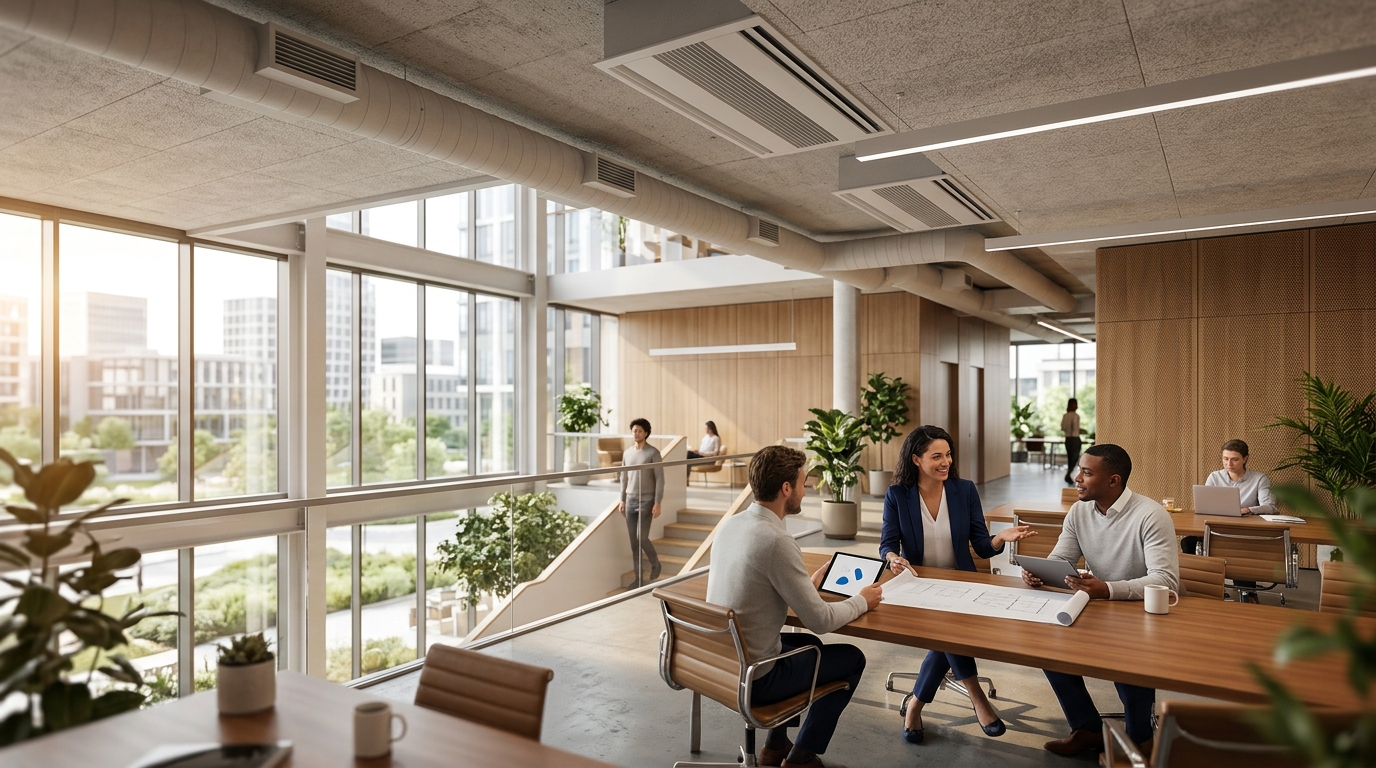
Commercial facilities require precise thermal regulation to maintain operational continuity and employee productivity. According to the U.S. Department of Energy, commercial buildings account for nearly 18 percent of total U.S. energy consumption, making climate control a critical financial factor. Commercial energy use directly impacts utility overhead and long-term asset value. Apex Clean Air delivers engineered solutions tailored to high-traffic environments, ensuring consistent temperature distribution across diverse operational zones.
Understanding Commercial Climate Control Systems
Commercial HVAC systems differ significantly from residential units due to scale and load requirements. Commercial HVAC systems are centralized mechanical networks designed to regulate temperature, humidity, and ventilation across multiple floors or expansive square footage. These systems require specialized engineering to handle variable occupancy rates and equipment heat loads. Facility managers must prioritize reliability to prevent operational downtime. Apex Clean Air provides comprehensive diagnostic services to evaluate existing infrastructure and identify efficiency gaps. Heating services and cooling diagnostics form the foundation of any successful facility upgrade.
Heating Solutions for Large Footprints
Cold climates demand robust thermal generation to maintain baseline comfort. Modern commercial heating relies on high-efficiency furnaces and advanced heat pump technology. Heat pump technology is a dual-function mechanical system that transfers thermal energy between indoor and outdoor environments to provide both heating and cooling. These units drastically reduce fossil fuel dependency while maintaining consistent output. Apex Clean Air installs commercial-grade heat pump systems that adapt to fluctuating outdoor temperatures. Heat pump installation ensures optimal capacity matching for your specific building layout. Facility owners also benefit from routine furnace maintenance to prevent unexpected breakdowns during peak winter months.
Advanced Cooling Strategies for Peak Efficiency
Summer heat loads can quickly overwhelm outdated mechanical equipment. Commercial cooling solutions must address both sensible and latent heat removal. Commercial cooling solutions are engineered mechanical processes that extract thermal energy and moisture from enclosed environments to maintain target temperature ranges. Rooftop units and split systems dominate the commercial sector due to their modular scalability. Apex Clean Air offers complete AC installation services to replace aging compressors with modern, refrigerant-efficient models. AC installation projects include precise load calculations to prevent short cycling and energy waste. Regular AC maintenance services extend equipment lifespan and preserve warranty coverage.
Indoor Air Quality Management Protocols
Thermal regulation alone does not guarantee a healthy workspace. Modern commercial buildings require active air purification to remove particulates and volatile compounds. Indoor air quality management is the systematic process of filtering, circulating, and sanitizing atmospheric conditions to minimize health risks and allergen exposure. Apex Clean Air implements advanced air purification services that capture microscopic contaminants without restricting airflow. Air purification services integrate seamlessly with existing ventilation networks to improve overall building health. Air duct cleaning services remove accumulated debris that compromises system efficiency and circulates pollutants. Air duct cleaning restores optimal airflow and reduces strain on mechanical components.
Zoning and Smart Building Controls
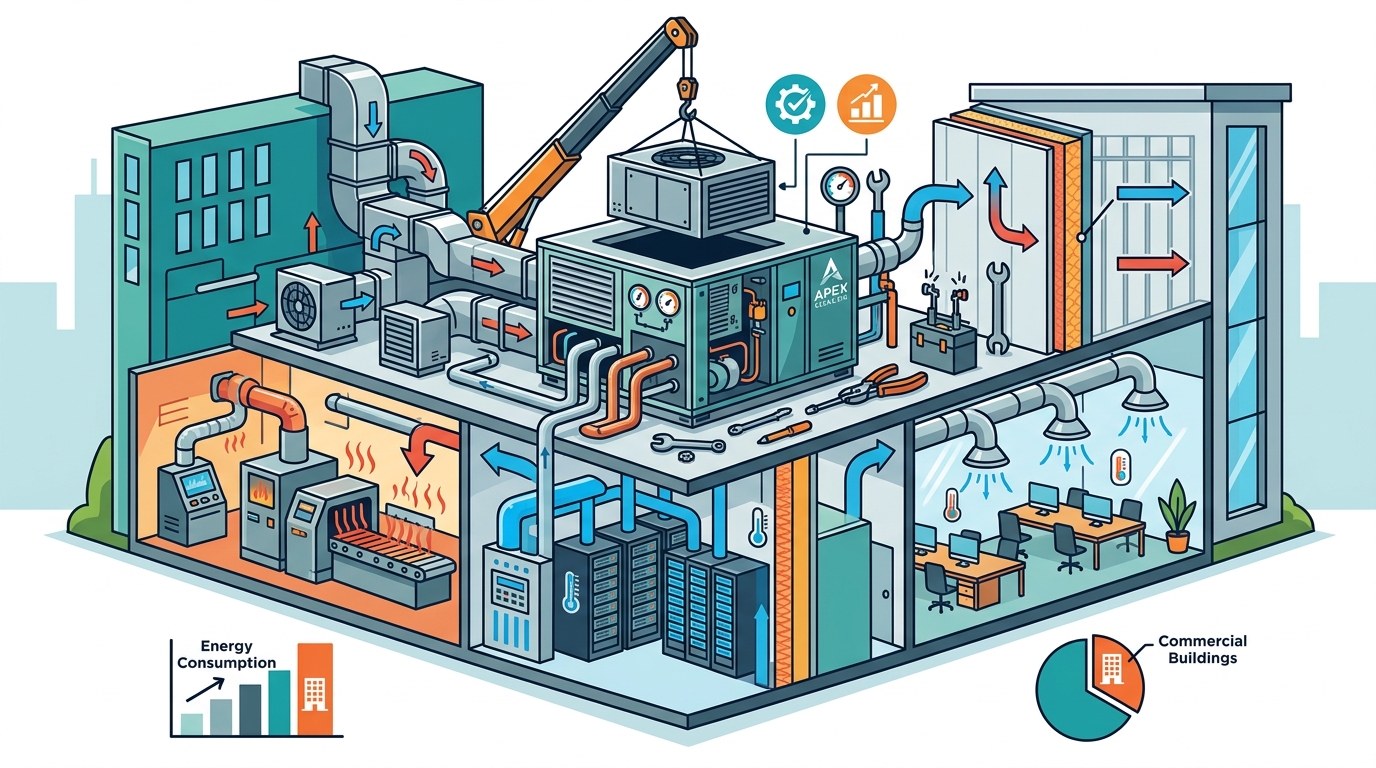
Large facilities experience uneven temperature distribution without proper zoning architecture. Smart thermostats and variable air volume systems allow independent climate control for distinct operational areas. Variable air volume systems are automated climate distribution networks that adjust airflow volume based on real-time thermal demand in specific zones. These systems reduce energy consumption by cooling or heating only occupied spaces. Apex Clean Air designs custom zoning layouts that align with your floor plan and usage patterns. Cooling diagnostic services identify airflow bottlenecks and recommend precise damper adjustments. Smart controls also integrate with building management software to track energy usage and automate scheduling.
| System Type | Primary Application | Efficiency Rating | Recommended Service |
|---|---|---|---|
| Rooftop Units | Single-story retail and warehouse spaces | Up to 20 SEER | AC maintenance services |
| Split Systems | Multi-story offices and medical facilities | Up to 18 SEER | Heating diagnostic services |
| Heat Pumps | Moderate climates with seasonal shifts | Up to 22 SEER | Heat pump repair |
| VAV Systems | Large commercial campuses and schools | Variable output | Indoor air quality testing |
Key Takeaways
- Commercial HVAC systems require specialized load calculations to prevent energy waste.
- Heat pump technology provides dual functionality for year-round thermal regulation.
- Variable air volume systems optimize energy distribution across occupied zones.
- Air purification services remove microscopic contaminants without restricting airflow.
- Routine AC maintenance services extend equipment lifespan and preserve warranty coverage.
- Smart building controls integrate with management software to automate scheduling.
- Apex Clean Air delivers comprehensive commercial solutions across multiple service areas.
Frequently Asked Questions
How do commercial HVAC systems differ from residential units?
Commercial systems utilize centralized mechanical networks designed to regulate temperature, humidity, and ventilation across multiple floors or expansive square footage. They feature modular components that scale to accommodate high occupancy rates and equipment heat loads.
What is the average lifespan of a commercial rooftop unit?
Commercial rooftop units typically operate for 15 to 20 years when subjected to regular preventive maintenance and proper load management. Building longevity depends heavily on filter replacement schedules and compressor inspections.
Can zoning controls reduce monthly utility expenses?
Variable air volume systems adjust airflow volume based on real-time thermal demand in specific zones. This targeted approach reduces energy consumption by cooling or heating only occupied spaces.
How often should commercial air ducts be cleaned?
Air duct cleaning services should be performed every three to five years to remove accumulated debris that compromises system efficiency. Industry guidelines recommend routine inspections to prevent particulate recirculation.
What maintenance schedule prevents unexpected equipment failure?
Apex Clean Air recommends biannual inspections to identify wear patterns before they cause operational downtime. Health standards require consistent filter changes and coil cleaning to maintain optimal airflow.
Do commercial heat pumps perform well in extreme winter conditions?
Modern heat pump technology transfers thermal energy between indoor and outdoor environments to provide both heating and cooling. Advanced inverter compressors maintain efficiency even when outdoor temperatures drop below freezing.
How does indoor air quality impact employee productivity?
Indoor air quality management is the systematic process of filtering, circulating, and sanitizing atmospheric conditions to minimize health risks and allergen exposure. Studies show that improved ventilation correlates with higher cognitive function and reduced sick days.
Schedule Your Commercial Consultation
Optimal commercial comfort requires precise engineering and proactive maintenance. Apex Clean Air provides comprehensive heating, cooling, and air quality solutions tailored to your facility. Contact your local office to schedule a detailed facility assessment. Our certified technicians will evaluate your current infrastructure and recommend customized upgrades. Visit https://apexcleanair.com to explore our full range of commercial services and financing options.