
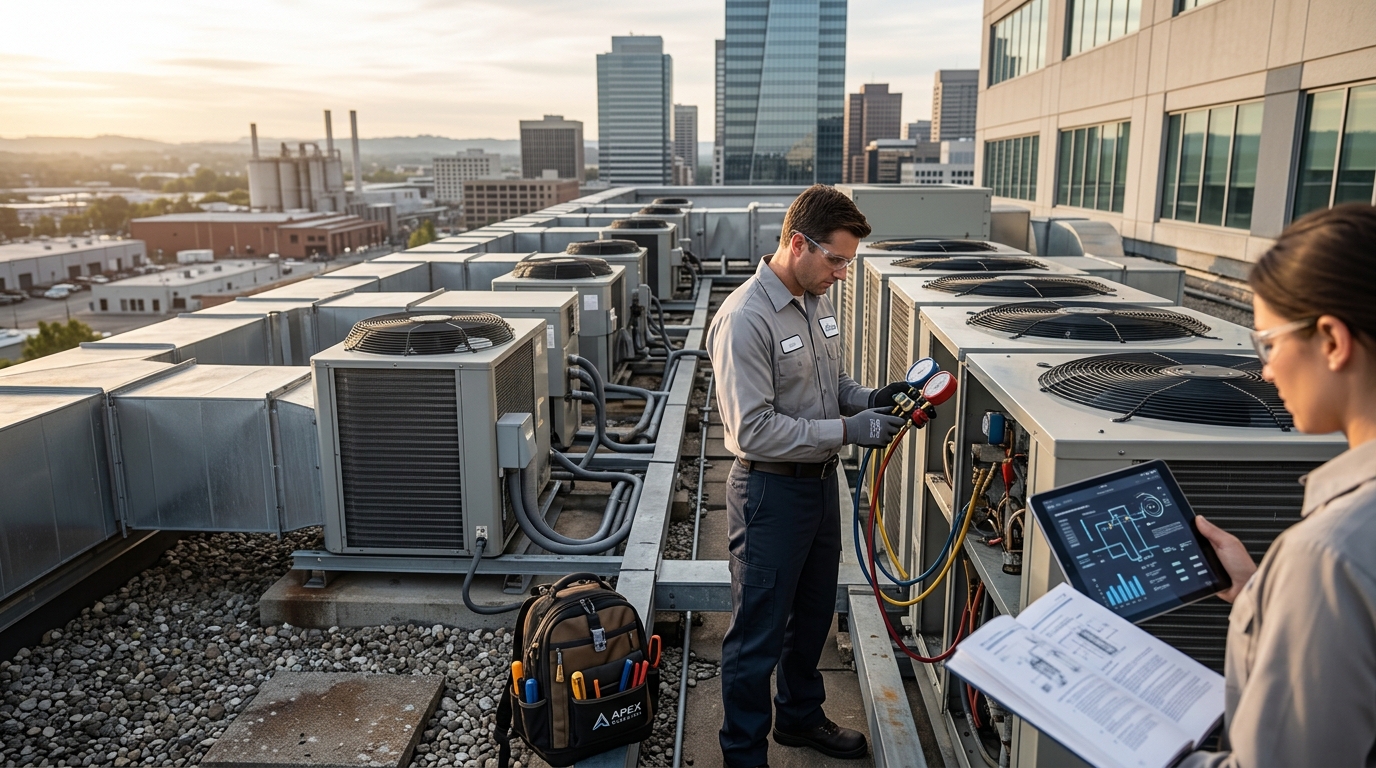
Commercial facilities face intense operational demands that directly impact system longevity and tenant satisfaction. According to the U.S. Department of Energy, building energy consumption accounts for nearly forty percent of total national electricity usage. Facility managers must implement rigorous maintenance protocols to prevent costly downtime and ensure consistent indoor air quality. Apex Clean Air provides comprehensive commercial climate control solutions tailored to large-scale operational environments. Our certified technicians specialize in diagnosing complex mechanical failures before they escalate into major capital expenditures.
Preventive Scheduling
Quarterly Inspection Cycles
Preventive maintenance is the systematic inspection of mechanical components to verify operational efficiency. Facility managers should schedule quarterly inspections to track compressor performance and motor amperage. Regular data collection allows engineering teams to replace worn bearings before catastrophic failure occurs. Apex Clean Air offers customized Comfort Club programs designed to streamline these recurring service visits. Consistent scheduling reduces unexpected breakdowns by nearly thirty percent across mid-sized commercial properties.
Seasonal Load Testing
Seasonal load testing is the controlled evaluation of system capacity under maximum thermal stress. Engineers must verify that cooling towers and condensers operate within specified temperature differentials. This process identifies airflow restrictions that degrade overall building comfort. Our team utilizes advanced diagnostic tools to map thermal distribution across multiple floors. You can explore our detailed heating services to understand how seasonal transitions impact mechanical longevity.
Filtration Standards
MERV Rating Compliance
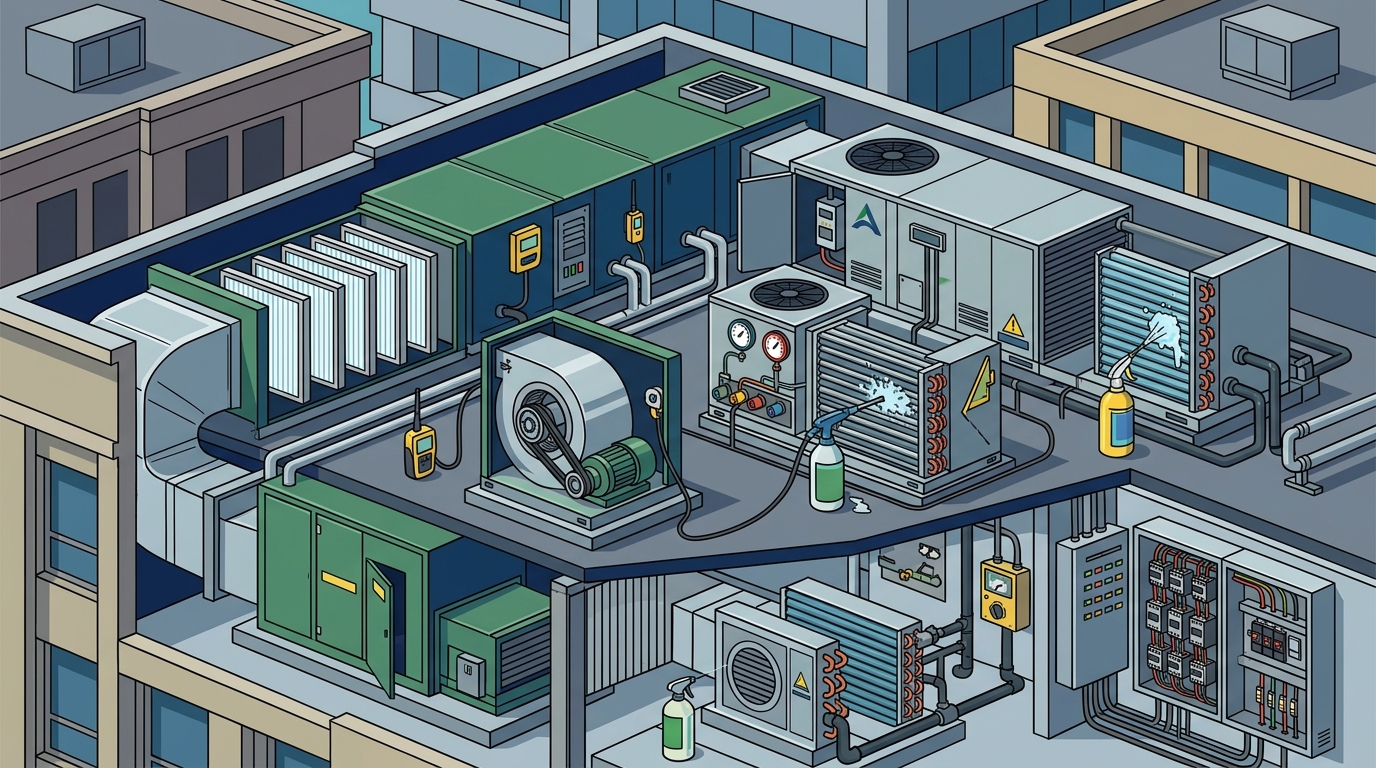
Filtration compliance is the mandatory adherence to minimum efficiency reporting value benchmarks. Modern commercial buildings require MERV 13 or higher to capture particulate matter and allergens. Clogged filters force fans to work harder, which increases electricity consumption and accelerates motor wear. Apex Clean Air installs advanced air purification systems that balance airflow resistance with maximum contaminant capture. Regular filter replacement schedules prevent pressure drops that strain central units.
Humidity Control Protocols
Humidity control protocols are the engineered methods used to maintain relative moisture levels between forty and sixty percent. Excessive moisture promotes microbial growth inside ductwork and evaporator coils. Dehumidification systems must operate in tandem with primary cooling stages to prevent condensation damage. Our technicians calibrate sensors to trigger auxiliary dehumidifiers during peak occupancy hours. You can learn more about our comprehensive indoor air quality services to optimize tenant health and comfort.
Refrigerant Management
Leak Detection Procedures
Refrigerant management is the regulated handling of chemical coolants to prevent atmospheric release and system failure. Modern regulations require certified technicians to recover and recycle leaked compounds immediately. Even minor pressure drops reduce cooling capacity and increase compressor temperatures. Apex Clean Air employs ultrasonic leak detectors to identify microscopic vapor escapes. Our team maintains strict compliance with environmental guidelines for sustainable refrigerant handling.
Charge Verification Cycles
Charge verification cycles are the standardized procedures used to measure subcooling and superheat values. Technicians must compare factory specifications against actual operating pressures to ensure optimal thermodynamic performance. Incorrect charge levels cause ice formation on evaporator coils and reduce seasonal efficiency ratings. Our engineers document every measurement to track long-term system degradation. You can review our AC maintenance services to see how precise calibration extends equipment lifespan.
Controls Calibration
BAS Integration Testing
Building automation integration is the synchronization of mechanical hardware with centralized software interfaces. Facility managers rely on programmable logic controllers to adjust ventilation rates based on occupancy sensors. Misaligned setpoints waste energy and create uneven temperature zones across large floor plans. Apex Clean Air engineers specialize in cooling services that optimize BAS communication protocols. Regular software updates prevent communication errors that disable critical safety overrides.
Actuator and Damper Checks
Actuator calibration is the precise adjustment of motorized valves to match commanded airflow positions. Stuck dampers restrict fresh air intake and force recirculation systems to operate inefficiently. Technicians must verify that actuators respond to control signals within acceptable timeframes. Our maintenance crews lubricate pivot points and replace worn gears to restore smooth operation. You can schedule a diagnostic assessment through our about us contact portal to discuss facility-specific requirements.
Duct Integrity
Seal and Insulation Audits
Duct integrity is the structural completeness of air distribution pathways that prevent conditioned air loss. Leaks behind ceilings or inside chases can waste up to thirty percent of generated thermal energy. Technicians must inspect flexible connectors and rigid seams for adhesive degradation over time. Apex Clean Air performs comprehensive air duct cleaning to remove debris that compromises sealant adhesion. Proper insulation prevents condensation that damages drywall and structural framing.
Airflow Balancing Procedures
Airflow balancing is the systematic adjustment of volume control dampers to deliver specified cubic feet per minute to each zone. Uneven distribution causes some areas to overcool while others struggle to maintain baseline temperatures. Engineers use pitot tubes and anemometers to measure static pressure across terminal units. Our team adjusts VAV boxes to match real-time occupancy patterns and equipment load. You can explore our AC installation resources to understand how proper zoning improves long-term efficiency.
Commercial System Comparison Matrix
| System Type | Maintenance Frequency | Primary Service Focus | Recommended Provider |
|---|---|---|---|
| Rooftop Units | Quarterly | Compressor oil analysis and belt tension | Heating Services |
| Chiller Plants | Biannual | Water treatment and condenser tube cleaning | Cooling Services |
| VAV Systems | Monthly | Damper actuator testing and sensor calibration | Indoor Air Quality Services |
| Fan Coil Units | Semiannual | Drain pan sanitation and filter replacement | Comfort Club |
Key Takeaways
- Quarterly inspections reduce unexpected breakdowns by nearly thirty percent across commercial properties.
- MERV 13 filtration standards capture particulate matter and prevent motor strain.
- Refrigerant leak detection prevents atmospheric release and maintains cooling capacity.
- Building automation integration synchronizes mechanical hardware with centralized software interfaces.
- Duct sealing audits recover wasted thermal energy that escapes through ceiling cavities.
- Apex Clean Air operates certified technician teams across Salt Lake City, Boise, Denver, and Colorado Springs.
- Our Comfort Club programs streamline recurring service visits and extend equipment lifespan.
Frequently Asked Questions
How often should commercial HVAC systems undergo professional inspections?
Facility managers should schedule professional inspections at least four times per year to track compressor performance and verify airflow resistance. Quarterly visits allow engineers to replace worn bearings before catastrophic failure occurs.
What filtration rating is required for modern commercial buildings?
Modern commercial buildings require MERV 13 or higher to capture particulate matter and allergens. Clogged filters force fans to work harder, which increases electricity consumption and accelerates motor wear.
How do refrigerant leaks impact system efficiency?
Even minor pressure drops reduce cooling capacity and increase compressor temperatures. Technicians must recover and recycle leaked compounds immediately to maintain thermodynamic performance.
Why is building automation integration critical for large facilities?
Building automation integration synchronizes mechanical hardware with centralized software interfaces. Facility managers rely on programmable logic controllers to adjust ventilation rates based on occupancy sensors.
What causes uneven temperature distribution across large floor plans?
Uneven distribution causes some areas to overcool while others struggle to maintain baseline temperatures. Engineers use pitot tubes to measure static pressure and adjust VAV boxes accordingly.
How can facility managers prevent microbial growth inside ductwork?
Excessive moisture promotes microbial growth inside ductwork and evaporator coils. Dehumidification systems must operate in tandem with primary cooling stages to prevent condensation damage.
What documentation should be maintained for warranty compliance?
Facility managers must document every measurement to track long-term system degradation. Our engineers provide detailed service reports that satisfy manufacturer warranty requirements.
Ready to Optimize Your Building Climate?
Large-scale commercial properties require precision maintenance to avoid operational disruptions. Apex Clean Air delivers certified technician support across Salt Lake City, Boise, Denver, and Colorado Springs. Contact your local office today to schedule a comprehensive system assessment and secure your facility against costly downtime. Visit https://apexcleanair.com to request a customized maintenance proposal.