

Running a business means juggling dozens of priorities, and your HVAC system probably does not top the list. But it should. Commercial heating and cooling equipment operates for thousands of hours each year, and without consistent upkeep, efficiency drops, repair bills climb, and your employees and customers notice the difference. Regular HVAC maintenance is the practice of scheduling routine inspections, cleanings, and tune-ups to keep commercial heating, ventilation, and air conditioning systems performing at peak levels. Below, we break down exactly why proactive HVAC care is one of the smartest investments a business can make.
Lower Energy Bills and Immediate ROI
HVAC systems can account for up to 40 percent of a commercial building's total energy consumption. When filters clog, coils collect grime, and refrigerant levels drift, the system works harder and burns more electricity to maintain the same temperature.
The U.S. Department of Energy estimates that following operations and maintenance best practices can save organizations 5 to 20 percent annually on energy bills. For a mid-size office spending $30,000 a year on utilities, that translates to $1,500 to $6,000 back in your budget without any major capital upgrade.
Quick Wins That Cut Costs
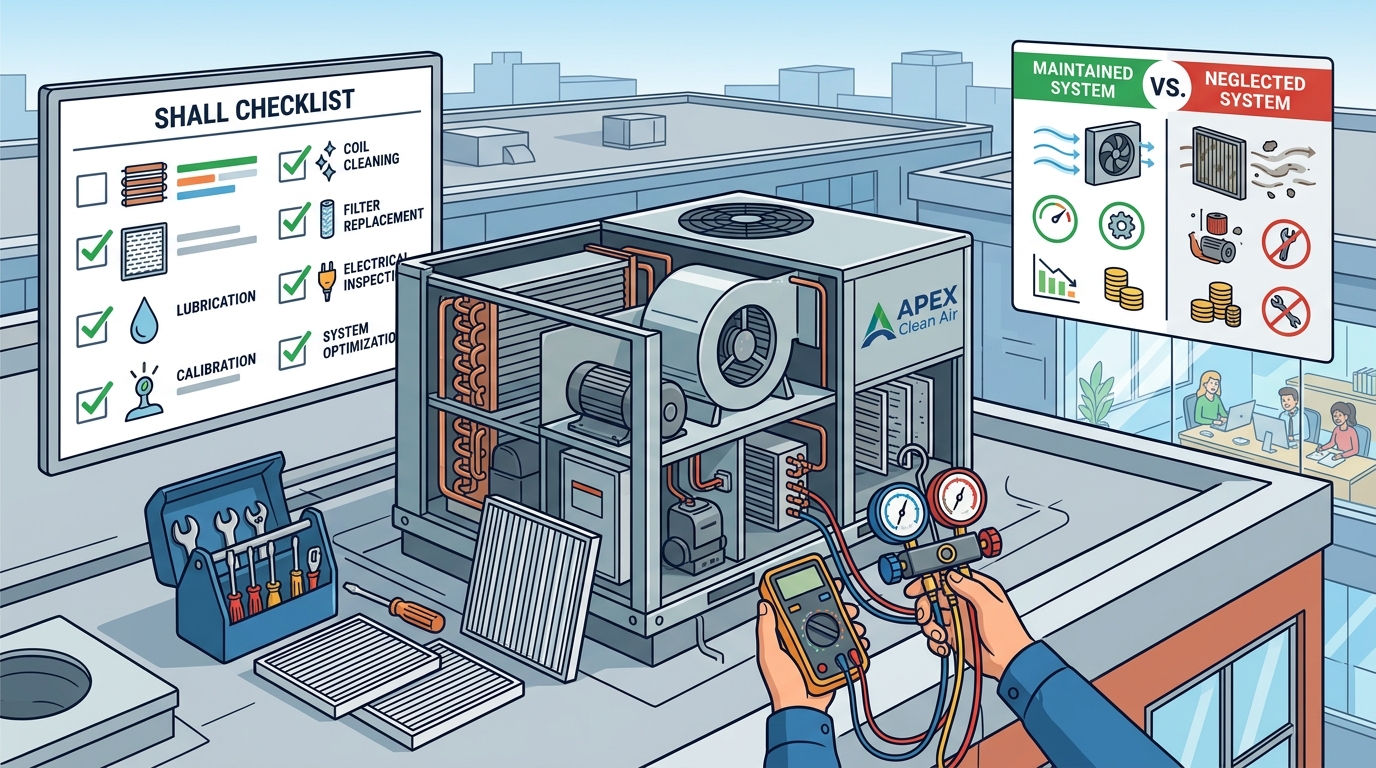
Replacing air filters every 30 to 90 days, cleaning evaporator and condenser coils, and verifying thermostat calibration are low-cost tasks that deliver measurable returns. Pairing these basics with a professional HVAC diagnostic service ensures nothing slips through the cracks.
Extended Equipment Lifespan
Commercial HVAC units represent a significant capital investment. Most commercial furnaces last 12 to 20 years and heat pumps 10 to 15 years with proper care. Skipping maintenance shortens those timelines dramatically, forcing premature replacements that strain capital budgets.
Routine tune-ups catch worn belts, failing capacitors, and minor refrigerant leaks before they cascade into compressor failures. The certified technicians at Apex Clean Air perform in-depth inspections that detect wear and emerging issues, helping businesses get the full expected life from their equipment.
Avoid Costly Emergency Repairs
Emergency HVAC service calls can cost 50 to 100 percent more than scheduled maintenance visits. According to the Pacific Partners Consulting Group, every $1 of deferred maintenance eventually becomes $4 in capital renewal costs. Reactive maintenance is a losing strategy for any business that values predictable budgets.
Preventive maintenance is the scheduled servicing of HVAC components to identify and resolve small problems before they cause system failure. Businesses that invest in a preventive plan experience significantly fewer surprise breakdowns and benefit from priority scheduling when issues do arise. Apex Clean Air's Comfort Club membership includes scheduled tune-ups, priority service, and exclusive member discounts to keep commercial clients covered year-round.
Better Indoor Air Quality for Employees and Customers
Indoor air quality (IAQ) is the condition of the air inside a building as it relates to the health and comfort of occupants. The EPA estimates that indoor air can be two to five times more polluted than outdoor air. In commercial settings, dust, pollen, mold spores, and volatile organic compounds circulate through ductwork and directly affect the people inside.
Regular maintenance, including filter replacement, coil cleaning, and professional air duct cleaning, removes contaminants before they recirculate. Apex Clean Air also offers advanced indoor air quality solutions such as UV germicidal lamps and whole-building air filtration that integrate directly with existing HVAC equipment.
Compliance, Safety, and Liability Reduction
ASHRAE Standard 180 establishes minimum inspection and maintenance requirements for commercial building HVAC systems. Many local jurisdictions adopt or reference this standard in their mechanical and energy codes. OSHA also requires employers to maintain safe working environments, which includes ensuring HVAC systems do not pose indoor air quality or electrical hazards.
Documented maintenance records help businesses demonstrate due diligence during inspections and can prevent fines or insurance complications. Properties pursuing LEED certification or ENERGY STAR benchmarking may also need audited HVAC performance data. Keeping a consistent maintenance schedule addresses all of these regulatory requirements proactively.
Employee Productivity and Customer Comfort
Temperature and air quality have a direct impact on how well people work. Organizations such as ASHRAE publish standards guiding healthy and efficient building temperatures because even small deviations can influence concentration and comfort. A malfunctioning AC unit does not just create discomfort; it can reduce employee output, drive away customers, and even force temporary closures.
For retail stores, restaurants, and offices across Utah and Colorado, maintaining a consistent and comfortable indoor climate is directly tied to revenue. Proactive HVAC care protects that bottom line.
Reactive vs. Preventive Maintenance: A Side-by-Side Look
| Factor | Reactive Maintenance | Preventive Maintenance |
|---|---|---|
| Cost per service call | 50-100% higher (emergency rates) | Lower, predictable monthly or annual cost |
| Annual energy savings | None; efficiency declines over time | 5-20% per DOE estimates |
| Equipment lifespan | Shortened by years of neglect | Full manufacturer-rated lifespan (15-20 yrs) |
| Downtime risk | High; unplanned outages | Low; issues caught early |
| Indoor air quality | Degrades as filters and coils go uncleaned | Consistently high with regular service |
| Compliance readiness | Gaps in documentation | Audit-ready maintenance records |
Key Takeaways
- Regular HVAC maintenance can save businesses 5 to 20 percent on annual energy bills according to the U.S. Department of Energy.
- HVAC systems account for roughly 40 percent of a commercial building's energy use, making efficiency gains highly impactful.
- Emergency repairs cost 50 to 100 percent more than planned maintenance visits.
- Every dollar of deferred maintenance leads to approximately four dollars in future capital renewal costs.
- Proper maintenance extends equipment life to the full 15-to-20-year manufacturer expectation.
- Improved indoor air quality reduces sick days and boosts employee productivity.
- Documented maintenance supports compliance with ASHRAE Standard 180, OSHA requirements, and local codes.
Frequently Asked Questions
How often should a business schedule HVAC maintenance?
Most commercial systems should receive professional maintenance at least twice a year, once before the cooling season and once before the heating season. High-use environments such as restaurants or data centers may need quarterly service.
What does a commercial HVAC tune-up include?
A typical tune-up covers filter replacement, coil cleaning, refrigerant level checks, electrical connection inspections, thermostat calibration, and a full system performance evaluation.
How much can preventive HVAC maintenance save a business?
The U.S. Department of Energy estimates savings of 5 to 20 percent on annual energy costs. Combined with fewer emergency repairs and extended equipment life, total savings can be substantial.
Does HVAC maintenance really improve indoor air quality?
Yes. Clean filters, sanitized coils, and professionally cleaned ductwork significantly reduce airborne dust, allergens, mold spores, and other pollutants circulating through a building.
Is commercial HVAC maintenance required by law?
While there is no single federal mandate, many states and municipalities reference ASHRAE Standard 180 in local codes. OSHA also requires employers to maintain safe air quality, making regular maintenance a practical compliance requirement.
What is the cost of ignoring HVAC maintenance?
Neglected systems consume up to 25 percent more energy, suffer more breakdowns, and typically need full replacement years earlier. Emergency service calls alone can double your repair expenses.
Can HVAC maintenance help my business meet sustainability goals?
Absolutely. Reducing energy consumption through proper maintenance lowers your carbon footprint and supports LEED or ENERGY STAR certification efforts.
Does Apex Clean Air service commercial properties?
Yes. Apex Clean Air provides HVAC maintenance, repair, installation, and air quality services for both residential and commercial clients across Utah, Colorado, and Idaho.
Schedule Your Commercial HVAC Tune-Up Today
Do not wait for a breakdown to remind you that your HVAC system needs attention. Apex Clean Air's certified technicians deliver thorough commercial maintenance services with same-day availability, transparent pricing, and a 100% workmanship guarantee. Contact our team today to build a preventive maintenance plan tailored to your business.