

If you manage a commercial property in Utah, Colorado, or Idaho, your HVAC system is one of your largest operating expenses and one of your most important assets. Regular HVAC maintenance is the practice of scheduling routine inspections, cleanings, and tune-ups to keep heating and cooling equipment running at peak performance. Neglecting it can lead to skyrocketing energy bills, unexpected breakdowns, and unhappy employees or customers. Below, we break down the proven benefits of proactive HVAC care and explain why it should be a priority for every business owner.
Significant Energy Cost Savings
HVAC equipment accounts for roughly 40 percent of energy usage in commercial buildings, according to the U.S. Small Business Administration. That means even small efficiency gains translate into meaningful dollar savings on your utility bills.
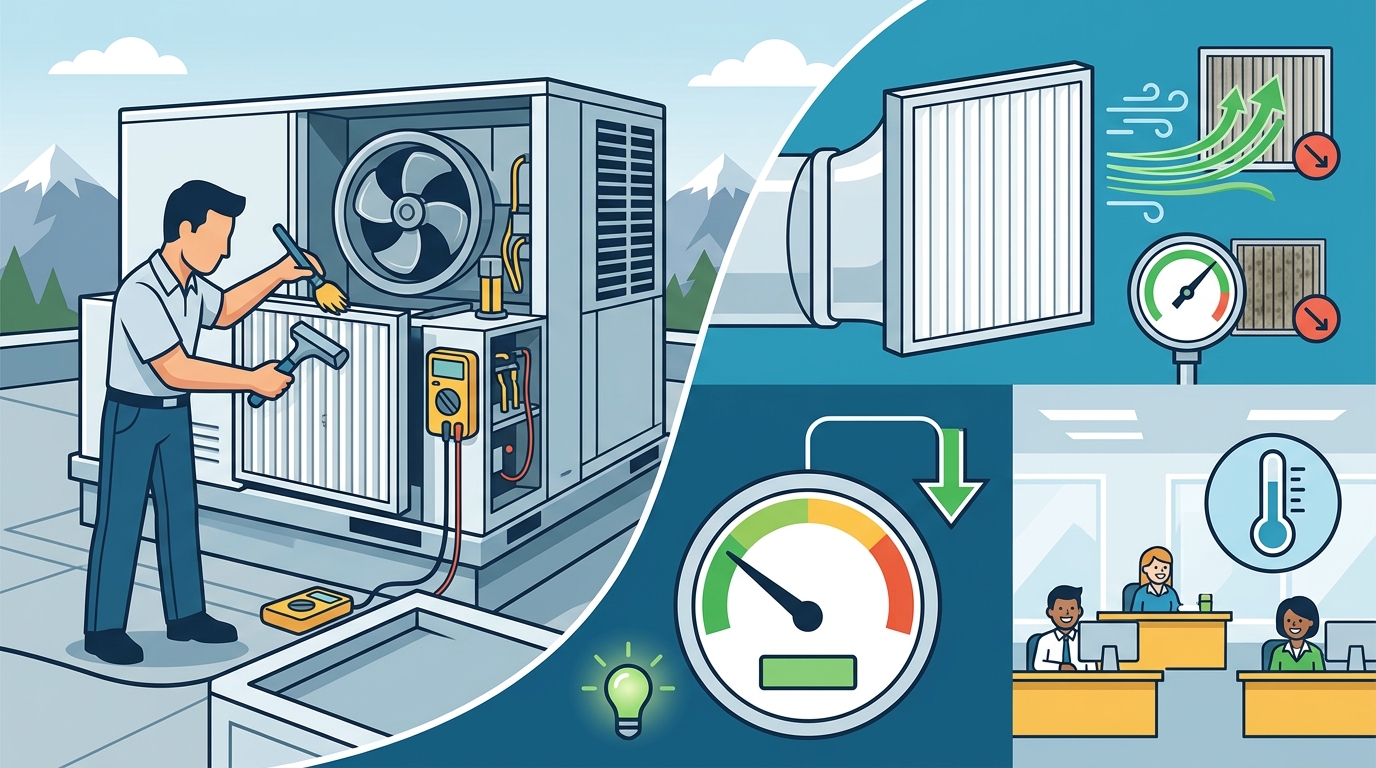
The U.S. Department of Energy estimates that effective operations and maintenance of commercial HVAC systems can save organizations 5 to 20 percent annually on energy costs. Tasks as simple as replacing air filters and cleaning coils can reduce fan and blower energy consumption by 41 to 60 percent, according to a 2024 study published in Energy and Buildings.
For a mid-size office spending $5,000 per month on utilities, even a 10 percent reduction means $6,000 saved each year. Those savings go straight to your bottom line. Our team at Apex Clean Air provides comprehensive commercial AC tune-ups designed to capture those efficiency gains for businesses across the Front Range and beyond.
Extended Equipment Lifespan
Preventive maintenance is a scheduled approach to servicing HVAC components before they fail, rather than waiting for a breakdown. Research shows that properly maintained systems achieve significantly extended operational life compared to those serviced only when something goes wrong.
The average commercial HVAC system lasts 15 to 20 years, but skipping routine care can shorten that timeline dramatically. Dust and debris buildup forces motors, compressors, and fans to work harder, accelerating wear on every component.
Our Denver HVAC maintenance services include in-depth inspections, deep cleaning of internal parts, and precise calibrations that help your equipment deliver steady, efficient performance for years longer than neglected systems.
Improved Indoor Air Quality
Indoor air quality (IAQ) is the measure of how clean and healthy the air inside a building is. Poor IAQ can trigger allergies, respiratory issues, and sick-building symptoms that lead to increased absenteeism among your workforce.
Dirty filters, clogged coils, and contaminated ductwork allow dust, pollen, mold spores, and bacteria to circulate throughout your commercial space. The American Lung Association recommends properly maintaining HVAC systems and upgrading filters to improve building air quality.
Apex Clean Air offers professional air duct cleaning services across Utah, Colorado, and Idaho that remove years of buildup and restore healthy airflow. Many of our commercial clients pair duct cleaning with HVAC diagnostics for a complete system refresh.
Fewer Costly Breakdowns
Emergency HVAC repairs cost 50 to 100 percent more than standard service calls, and running equipment to failure costs 3 to 10 times more than a proper maintenance program. For businesses, an unexpected system failure does not just mean a repair bill. It can mean lost revenue, spoiled inventory, and dissatisfied customers.
Comprehensive planned maintenance programs result in a 50 percent reduction in total maintenance costs compared to reactive approaches. Predictive maintenance algorithms applied to HVAC systems have been shown to reduce system breakdowns by 70 to 75 percent.
Whether you operate a retail store in Salt Lake City or a warehouse in Colorado Springs, proactive service from Apex Clean Air helps you avoid those disruptive, budget-busting emergencies.
Better Employee Productivity and Comfort
Temperature control directly impacts how well your team performs. Research cited by ASHRAE shows that small changes in indoor temperature can influence worker concentration and comfort. A malfunctioning AC unit can reduce employee productivity, drive away customers, and even force temporary business closures.
A well-maintained HVAC system keeps temperatures consistent across zones, eliminates hot and cold spots, and manages humidity levels. The result is a workspace where people can focus on their jobs instead of their discomfort.
Reactive vs. Preventive Maintenance Comparison
| Factor | Reactive Maintenance | Preventive Maintenance |
|---|---|---|
| Annual Energy Savings | 0% | 5-20% |
| Equipment Lifespan | Shortened by 30%+ | Full rated lifespan (15-20 yrs) |
| Breakdown Frequency | High | Reduced by 70-75% |
| Repair Cost Premium | 50-100% higher (emergency rates) | Standard service rates |
| Total Maintenance Cost | Baseline | 50% lower than reactive |
| Indoor Air Quality | Degrades over time | Consistently maintained |
Key Takeaways
- Regular HVAC maintenance can save businesses 5 to 20 percent on annual energy bills.
- Preventive programs cut total maintenance costs by up to 50 percent versus reactive approaches.
- Clean coils and filters alone can reduce fan energy consumption by 41 to 60 percent.
- Emergency repairs cost 50 to 100 percent more than scheduled service visits.
- Proper maintenance extends commercial HVAC equipment to its full 15- to 20-year lifespan.
- Better indoor air quality reduces employee absenteeism and boosts workplace productivity.
- Businesses in Utah, Colorado, and Idaho face extreme temperature swings that make proactive HVAC care especially critical.
Frequently Asked Questions
How often should a business schedule HVAC maintenance?
Most commercial HVAC professionals recommend at least two maintenance visits per year, one before the cooling season and one before the heating season. Businesses in high-dust or extreme-climate areas may benefit from quarterly check-ups.
What does a commercial HVAC maintenance visit include?
A typical visit includes filter inspection and replacement, coil cleaning, electrical connection checks, refrigerant level verification, thermostat calibration, and a full system performance assessment.
How much can regular maintenance save on energy costs?
The U.S. Department of Energy estimates savings of 5 to 20 percent annually. For a business spending $60,000 per year on energy, that translates to $3,000 to $12,000 in annual savings.
Does HVAC maintenance really extend equipment life?
Yes. Well-maintained commercial systems consistently reach their full rated lifespan of 15 to 20 years. Neglected systems often require replacement years earlier, at significantly higher capital cost.
Can dirty ducts affect my business?
Absolutely. Contaminated ductwork circulates dust, allergens, and mold spores that reduce air quality, trigger employee health issues, and force the system to work harder. Professional duct cleaning restores healthy airflow and system efficiency.
What are the signs my commercial HVAC needs maintenance?
Watch for rising energy bills without increased usage, inconsistent temperatures across zones, unusual noises, frequent cycling, visible dust around vents, and musty odors when the system runs.
Is preventive maintenance worth the upfront cost?
Every dollar of deferred maintenance becomes roughly four dollars in capital renewal costs, according to the Pacific Partners Consulting Group. Preventive programs deliver a strong return on investment by avoiding costly emergency repairs and premature equipment replacement.
Does Apex Clean Air service commercial properties?
Yes. Apex Clean Air provides commercial HVAC repair, maintenance, and air quality services across Utah, Colorado, and Idaho, with offices in Salt Lake City, Denver, Colorado Springs, and Boise.
Schedule Your Commercial Maintenance Today
Do not wait for a breakdown to disrupt your business. Contact Apex Clean Air to schedule a comprehensive commercial HVAC maintenance visit. Our certified technicians serve businesses throughout Utah, Colorado, and Idaho with same-day availability, transparent pricing, and a 100 percent workmanship guarantee.