

Maintaining HVAC systems in large commercial buildings is one of the most impactful investments a facility manager can make. Without a proactive maintenance plan, energy costs spike, equipment life shortens, and occupant comfort suffers. According to the U.S. Department of Energy, regular coil cleaning alone can reduce energy consumption by 30% to 40%. This guide walks you through the essential best practices that keep commercial HVAC systems running efficiently across Utah, Colorado, Idaho, and beyond. Whether you manage a retail center, office tower, or warehouse, these strategies will protect your investment and improve indoor air quality for everyone inside.
Why Preventive Maintenance Is Non-Negotiable
Preventive maintenance is a scheduled program of inspections, adjustments, and part replacements designed to catch small issues before they escalate into costly failures. For large commercial buildings, an unplanned HVAC shutdown can halt operations, reduce employee productivity, and even force temporary closures.
A proactive approach protects your HVAC investment, ensures business continuity, and keeps employees and customers comfortable. Facility managers should schedule professional inspections at least twice per year, ideally before summer cooling season and winter heating season. Our HVAC services overview explains the core system components every building manager should understand.
Annual Inspection Checklist
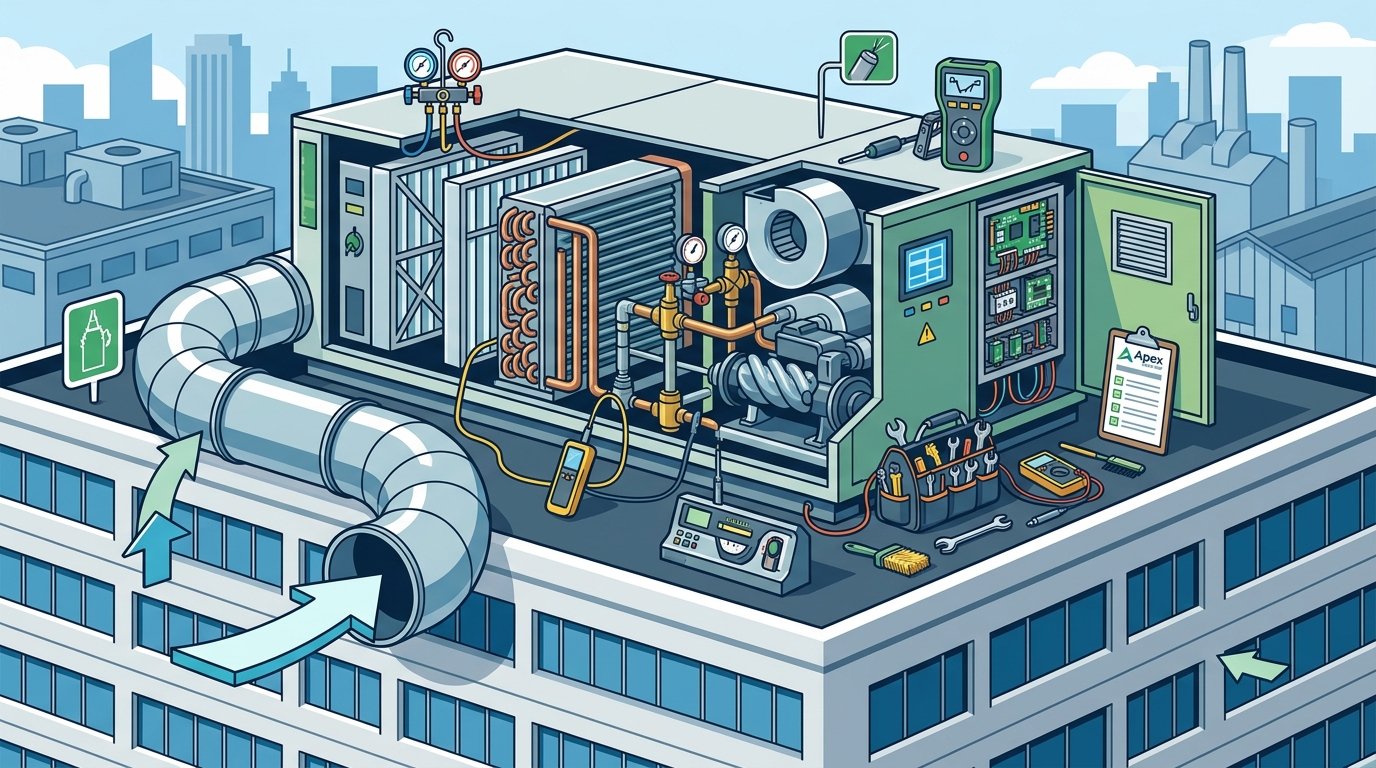
A thorough annual inspection should cover refrigerant levels, electrical connections, thermostat calibration, belt tension, and condensate drain lines. Annual exhaust outlet inspections are also critical because even small carbon monoxide leaks pose serious safety risks.
Service Level Agreements
Establish a clear service level agreement (SLA) with your HVAC provider. An SLA is a documented commitment outlining response times, covered services, and performance benchmarks. This ensures priority scheduling and predictable budgeting for your facility.
Filter Management and Replacement Schedules
Air filters are the first line of defense against airborne contaminants entering your HVAC system. A clogged air filter restricts airflow, forces the system to work harder, reduces efficiency, and can cause other components to fail. In commercial buildings with high foot traffic, filters may need monthly inspection and quarterly replacement.
Use filters rated MERV 13 or higher for commercial environments to capture fine particulate matter, pollen, and bacteria. Proper filters and good filter-changing habits are critical to long-lasting systems. Track replacement dates digitally so nothing slips through the cracks.
Duct Cleaning and Airflow Optimization
Ductwork is the circulatory system of your building's HVAC. Over time, ducts accumulate dust, debris, and various contaminants that negatively impact air quality and aggravate allergies and respiratory issues. Professional air duct cleaning removes these accumulations and significantly improves building-wide air quality.
When to Schedule Duct Cleaning
Even with high-quality HEPA filters, ductwork should be cleaned every two to three years. Buildings in areas with high dust or pollen levels, common across Utah and Colorado, may require more frequent service. Spring and early autumn are ideal times because HVAC usage is typically lower.
Balancing Airflow
Unbalanced airflow creates hot and cold zones that waste energy and reduce comfort. Technicians should test static pressure at multiple points and adjust dampers to ensure uniform distribution. This step is often overlooked but delivers immediate energy savings.
Energy Efficiency Audits and Monitoring
An energy efficiency audit is a systematic evaluation of how your HVAC system consumes energy compared to industry benchmarks. The EPA's ENERGY STAR program provides tools for benchmarking commercial building performance.
| Maintenance Task | Frequency | Estimated Energy Savings |
|---|---|---|
| Coil cleaning | Annually | 30%-40% |
| Filter replacement | Quarterly | 5%-15% |
| Duct sealing | Every 3-5 years | 20%-30% |
| Thermostat calibration | Biannually | 3%-5% |
| Belt and motor inspection | Biannually | 2%-5% |
Building automation systems (BAS) allow real-time monitoring of temperature, humidity, and equipment status. Pairing a BAS with scheduled maintenance maximizes efficiency and extends equipment lifespan.
Seasonal Preparation for Mountain-West Climates
Utah, Colorado, and Idaho experience dramatic temperature swings, from blazing summers to freezing winters. This unique climate demands specialized HVAC preparation. Our teams in Denver and Salt Lake City have years of experience designing maintenance plans for these conditions.
Summer Prep
Before peak cooling season, inspect condenser coils, verify refrigerant charge, and test economizer operation. Colorado's dry climate accelerates dust buildup on outdoor units, so condenser washing should be done at least twice during summer months.
Winter Prep
Heading into winter, focus on furnace ignition systems, heat exchanger integrity, and gas line connections. In mountain-region buildings, heat pump installations are increasingly popular for their versatility and energy efficiency. Consult our Provo HVAC team for heat pump sizing and seasonal tune-ups.
Indoor Air Quality Controls
Indoor air quality (IAQ) is the measure of how clean and healthy the air inside a building is relative to occupant comfort and safety. Poor IAQ in commercial buildings can stem from inadequate ventilation, chemical off-gassing, and biological contaminants like mold.
Advanced solutions such as UVC lighting systems lower airborne pathogens and improve HVAC efficiency simultaneously. Ionizers that produce minimal or no ozone can eliminate pollutants without creating secondary health risks. Humidity control through commercial-grade humidifiers prevents virus and bacteria spread while protecting building materials.
Dust, pollen, and wildfire smoke are common concerns across the Mountain West. Combining duct cleaning, air purification systems, and HVAC diagnostics creates a layered defense strategy. Learn more about our indoor air quality solutions in Ogden.
Key Takeaways
- Schedule professional HVAC inspections at least twice per year, before cooling and heating seasons.
- Replace commercial air filters quarterly (or monthly in high-traffic buildings) using MERV 13+ rated filters.
- Clean ductwork every two to three years to maintain airflow and indoor air quality.
- Conduct annual coil cleaning to achieve up to 30%-40% energy savings.
- Invest in building automation systems for real-time monitoring and faster issue detection.
- Tailor seasonal maintenance to Mountain-West climate demands, including condenser washing and heat exchanger checks.
- Layer IAQ strategies by combining UVC lighting, ionizers, humidity control, and regular duct cleaning.
Frequently Asked Questions
How often should commercial HVAC systems be serviced?
Commercial HVAC systems should receive professional maintenance at least twice per year. Buildings with 24/7 operations or extreme climate exposure may benefit from quarterly service visits to catch wear before it becomes a breakdown.
What is the most important HVAC maintenance task for energy savings?
Coil cleaning delivers the largest single impact on energy efficiency. The U.S. Department of Energy estimates that clean coils can reduce energy costs by 30% to 40%, making it the highest-ROI maintenance activity.
How do I know when my commercial ductwork needs cleaning?
Warning signs include visible dust around vents, musty odors from supply registers, inconsistent temperatures across zones, and unexpectedly high energy bills. Professional inspection can confirm whether cleaning is needed.
Are building automation systems worth the investment?
Yes. A building automation system (BAS) provides real-time data on equipment performance, allowing facility managers to detect anomalies early and optimize run schedules. Most commercial buildings see ROI within two to three years through energy savings alone.
What filter rating should I use for a commercial building?
MERV 13 or higher is recommended for most commercial environments. This rating captures particles down to 0.3 microns, including bacteria, pollen, and fine dust, without creating excessive pressure drop in standard systems.
How does wildfire smoke affect commercial HVAC systems in the Mountain West?
Wildfire smoke introduces fine particulate matter that clogs filters faster, coats coils, and degrades indoor air quality. During smoke events, increase filter inspection frequency to weekly and consider supplemental air purification systems.
What is the average lifespan of a commercial HVAC system?
A well-maintained commercial HVAC system typically lasts 15 to 20 years. Neglecting routine maintenance can cut that lifespan in half, resulting in premature and expensive replacement.
Protect Your Commercial Building's HVAC Investment
Ready to build a maintenance plan tailored to your commercial property? Apex Clean Air's certified technicians serve businesses across Utah, Colorado, and Idaho with same-day diagnostics, preventive maintenance programs, and advanced air quality solutions. Contact Apex Clean Air today to schedule your commercial HVAC assessment and keep your building running at peak performance.