

Cooling Solutions for Large Homes: Systems, Sizing, and Expert Tips
Keeping a large home cool during summer is no small feat. Properties over 2,500 square feet face unique challenges: uneven temperatures between floors, long ductwork runs, and higher energy bills. The good news is that modern cooling technology offers several effective solutions, from high-efficiency central air conditioners to versatile heat pump systems. This guide breaks down every option, explains how to size equipment correctly, and shows you how to maximize efficiency so your large home stays comfortable without wasting energy or money.
Why Large Homes Need Specialized Cooling
Large residential properties present cooling challenges that standard single-zone systems simply cannot handle. More square footage means greater thermal load, longer duct runs, and more opportunities for conditioned air to lose energy before reaching distant rooms.
Homes in regions with dramatic temperature swings, like the Rocky Mountain states, face additional complexity. Colorado, Utah, and Idaho experience blazing summers alongside freezing winters, which demands HVAC solutions that adapt to wide climate extremes. A local contractor familiar with these conditions will design a system tuned to your region's specific heating and cooling demands.
Common Problems in Under-Served Large Homes
- Hot spots on upper floors while ground-level rooms stay cool
- An overworked single AC unit that cycles constantly
- Rising energy bills without improved comfort
- Excess humidity from inadequate dehumidification
Types of Cooling Systems for Large Properties
Choosing the right system type is the single most impactful decision for large-home comfort. Below is a comparison of the most effective options.
| System Type | Best For | Efficiency | Dual Heating/Cooling |
|---|---|---|---|
| Central Air Conditioner | Homes with existing ductwork | 13.4 - 24+ SEER2 | No (cooling only) |
| Air-Source Heat Pump | Year-round climate control | 14.3 - 22+ SEER2 | Yes |
| Ductless Mini-Split | Zoned cooling, additions, no ducts | 15 - 25+ SEER2 | Yes |
| Geothermal Heat Pump | Maximum long-term savings | 30+ EER equivalent | Yes |
| Zoned Ducted System | Multi-story large homes | Varies by equipment | Depends on setup |
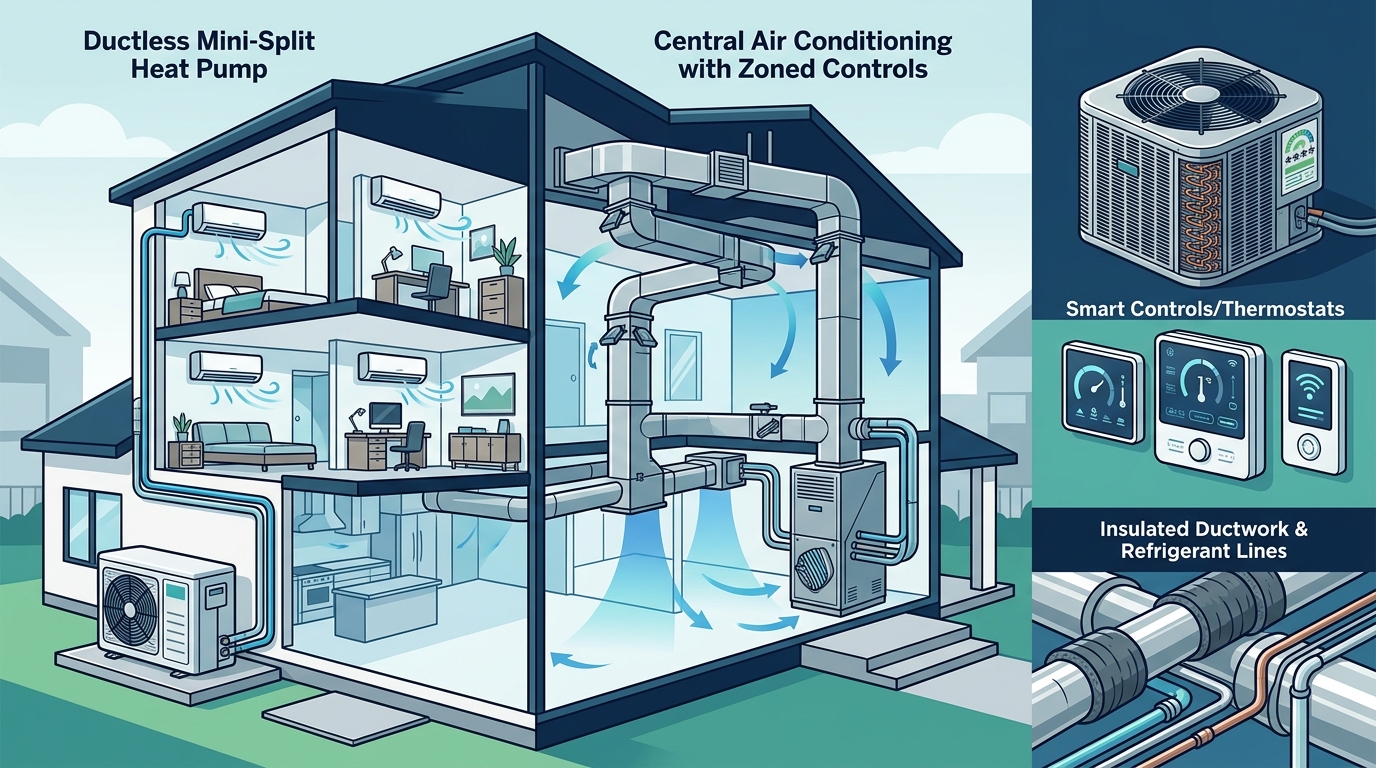
Central Air Conditioning
Central AC is the most common cooling method for large homes with existing ductwork. A properly sized central system pushes conditioned air through supply ducts and returns warm air for re-cooling. For properties above 3,000 square feet, a multi-stage or variable-speed compressor delivers steadier temperatures and better humidity control than a basic single-stage unit.
Heat Pumps: The Versatile Choice
A heat pump is an HVAC system that transfers heat rather than generating it, providing both heating and cooling from a single unit. Air-source heat pumps (ASHPs) are the most popular variety, exchanging heat between your home and the outdoor air. Ground-source heat pumps (GSHPs), also called geothermal systems, use the earth's stable underground temperature for even greater efficiency. Modern cold-climate heat pumps are engineered to operate effectively down to approximately -13 degrees Fahrenheit, making them a viable option in states like Utah, Colorado, and Idaho. Professional heat pump installation ensures the system is matched to your home's exact load requirements.
Ductless Mini-Splits for Zoned Comfort
A ductless mini-split is a cooling (and often heating) system that delivers conditioned air directly to individual rooms without ductwork. For large homes with additions, sunrooms, or finished attics, mini-splits provide targeted cooling to hard-to-reach zones. They can also supplement a central system to eliminate hot spots.
Proper System Sizing and Load Calculations
Getting the size right is the most critical step in any cooling installation. An oversized unit will short-cycle, wasting energy, wearing components prematurely, and failing to dehumidify properly. An undersized unit will struggle to keep up on the hottest days. According to industry data, roughly 32% of HVAC installations are improperly sized, which is why a professional assessment matters.
HVAC professionals use a Manual J load calculation to determine the precise cooling capacity your home needs. Manual J is a standardized method that analyzes your home's square footage, insulation levels, window orientation, local climate data, and occupancy to calculate the exact BTU output required. For large properties, this calculation is non-negotiable. Learn more about how load calculations work during installation.
Understanding SEER2 Efficiency Standards
SEER2 is the Seasonal Energy Efficiency Ratio 2, the updated U.S. Department of Energy standard for measuring cooling efficiency that replaced the original SEER system in January 2023. The new M1 testing procedure increased external static pressure by a factor of five to better reflect real-world duct conditions, which means SEER2 numbers appear lower than old SEER ratings for the same equipment even though actual efficiency has not changed.
For homeowners in the northern U.S., the current federal minimum is 13.4 SEER2 for central air conditioners. Southern and southwestern states require 14.3 SEER2 or higher. Through the Inflation Reduction Act, homeowners can claim up to $2,000 in federal tax credits for qualifying high-efficiency heat pumps, making premium systems more accessible than ever.
For most homeowners, a system in the 15 to 17 SEER2 range offers the best balance between upfront cost and long-term savings, delivering 25 to 35 percent lower cooling costs compared to minimum-efficiency units.
Indoor Air Quality and Ductwork Considerations
Cooling a large home effectively is not just about temperature; it is also about the air you breathe. Long duct runs accumulate dust, pollen, pet dander, and even mold spores over time, degrading airflow and circulating irritants throughout your living space. Regular professional duct cleaning and coil maintenance restores airflow, reduces allergens, and boosts overall HVAC efficiency.
Air purification adds another layer of protection. Systems ranging from HEPA filters to advanced UV and REME Halo units can be integrated into your existing HVAC setup. For large homes in areas affected by wildfire smoke or high pollen counts, these solutions make a measurable difference in indoor comfort and family health.
Maintenance Strategies to Maximize Performance
Even the best cooling system will lose efficiency without regular upkeep. Skipping annual maintenance might seem harmless, but dust buildup, clogged filters, and minor wear can all escalate into major problems if ignored.
Seasonal Tune-Up Checklist
- Inspect and clean evaporator and condenser coils
- Check refrigerant levels and test for leaks
- Verify electrical connections and capacitor health
- Calibrate thermostat and test smart controls
- Clear condensate drain lines
- Replace or clean air filters
HVAC experts recommend two professional tune-ups per year: one in the spring before cooling season and one in the fall before heating season. Enrolling in a maintenance membership program simplifies scheduling while providing priority service and member discounts.
Key Takeaways
- Large homes over 2,500 sq ft benefit from zoned, multi-stage, or variable-speed cooling systems to eliminate hot spots.
- Heat pumps provide both heating and cooling from a single unit and perform well in cold climates down to -13 degrees Fahrenheit.
- A Manual J load calculation is essential to avoid the costly problems caused by oversized or undersized equipment.
- SEER2 replaced SEER in January 2023 and provides more accurate real-world efficiency ratings.
- Systems rated 15 to 17 SEER2 offer the best balance of cost and savings for most homeowners.
- The Inflation Reduction Act offers up to $2,000 in federal tax credits for qualifying heat pumps.
- Annual maintenance, including coil cleaning, refrigerant checks, and filter changes, prevents breakdowns and extends system life.
Frequently Asked Questions
What is the best cooling system for a home over 3,000 square feet?
A zoned central air conditioner or a ducted heat pump with a variable-speed compressor is typically the best choice. Zoning allows different areas of the home to be cooled independently, eliminating hot spots and reducing energy waste.
How do I know if my AC is properly sized for my large home?
A certified HVAC technician should perform a Manual J load calculation that accounts for your home's square footage, insulation, windows, and local climate. If your system short-cycles or fails to maintain even temperatures, it may be improperly sized.
What is SEER2 and why does it matter?
SEER2 stands for Seasonal Energy Efficiency Ratio 2. It is the current DOE standard for measuring cooling efficiency, replacing the original SEER metric in January 2023. Higher SEER2 numbers mean lower electricity consumption and smaller utility bills.
Are heat pumps effective in cold climates like Utah and Colorado?
Yes. Modern cold-climate heat pumps operate efficiently down to approximately -13 degrees Fahrenheit. For extreme cold, hybrid dual-fuel systems pair a heat pump with a gas furnace for backup, ensuring you are never left without heat.
How often should I schedule AC maintenance for a large home?
Twice per year is recommended: once in the spring before cooling season and once in the fall before heating season. Regular tune-ups prevent breakdowns, extend equipment life, and keep efficiency high.
Can ductless mini-splits work alongside my central AC?
Absolutely. Mini-splits are ideal for supplementing a central system in hard-to-cool zones like attics, additions, or upper floors. They operate independently and do not require ductwork.
What tax credits are available for energy-efficient cooling systems?
Under the Inflation Reduction Act, homeowners can claim up to $600 for qualifying central AC systems and up to $2,000 for qualifying heat pumps. Systems must meet specific ENERGY STAR efficiency thresholds to be eligible.
How much can I save by upgrading to a higher SEER2 system?
Upgrading from a 14 SEER2 to a 20 SEER2 system can save approximately $300 to $400 per year on cooling costs for a typical home, depending on climate, usage, and local electricity rates.
Get Expert Cooling for Your Large Home
Ready to find the right cooling solution for your property? Schedule a free consultation with Apex Clean Air and get a professional load assessment, transparent pricing, and flexible financing options tailored to your home's needs. With offices across Utah, Colorado, and Idaho, expert help is always close by.