

Your HVAC air filter is one of the most overlooked yet impactful components of your home comfort system. A clean filter keeps your energy bills in check, extends equipment life, and—most importantly—protects the air your family breathes every day. But the question homeowners ask us most at Apex Clean Air is simple: how often should I actually change my filter?
The short answer is every 30 to 90 days for standard 1-inch filters, but the real answer depends on your household, your filter type, and your local environment. This guide breaks down every variable so you can build a replacement schedule that truly fits your home.
Why Your HVAC Air Filter Matters More Than You Think
Before we talk timing, it is worth understanding what your filter actually does. HVAC filters trap dust, pollen, pet dander, mold spores, and other airborne contaminants as your system circulates air through your home. Think of the filter as a gatekeeper that prevents those particles from recirculating into your living spaces and from coating the sensitive internal components of your furnace or air handler.
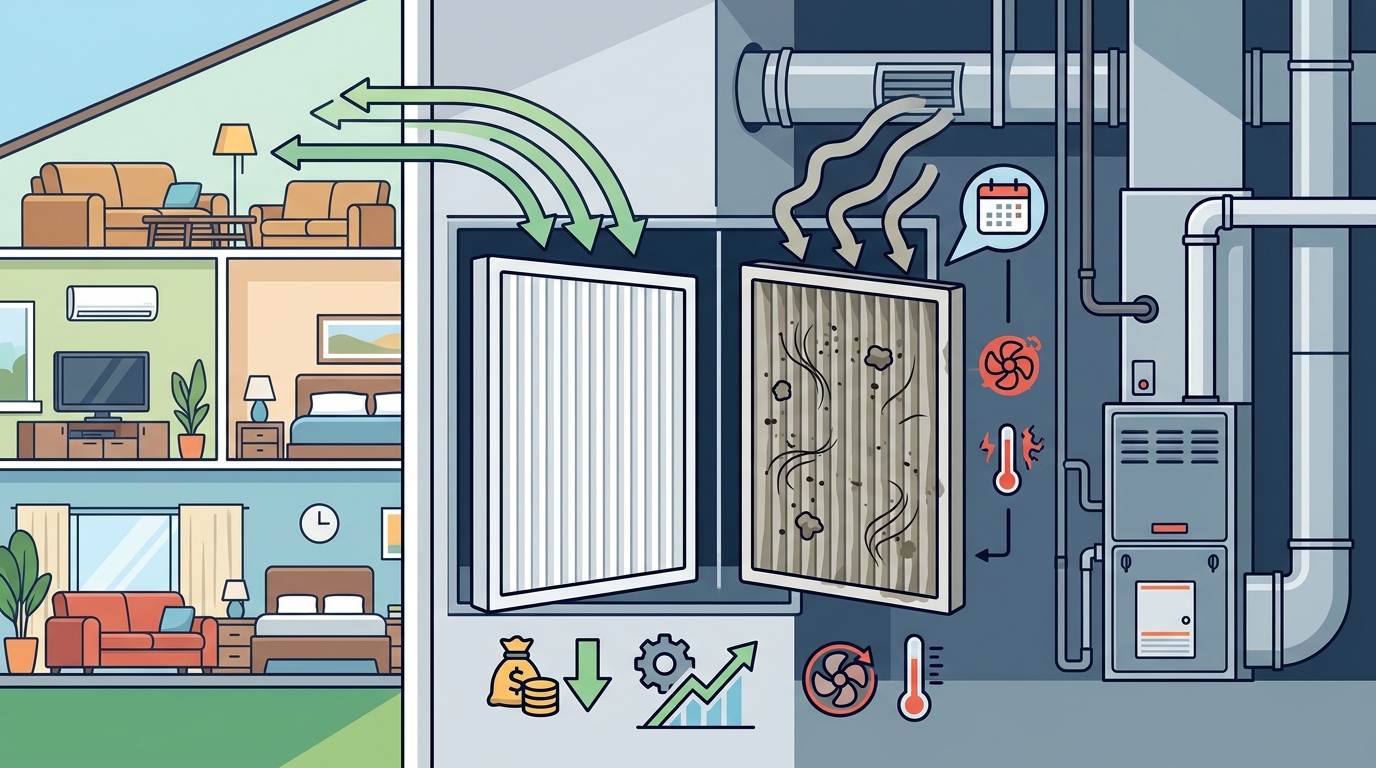
When a filter becomes clogged, it restricts airflow. This forces the blower motor and other components to work harder, which can lead to premature wear, higher energy bills, and even complete system failure. A dirty filter also allows pollutants to bypass filtration entirely, degrading your indoor air quality precisely when you need protection the most.
The General Rule: Every 90 Days
Industry consensus from manufacturers and HVAC professionals is that a standard pleated filter should be replaced roughly every 90 days—about once per quarter. This baseline assumes a typical household without pets, allergies, or extreme climate demands. It is grounded in the principle that regular maintenance is essential for both system performance and healthy indoor air.
However, 90 days is only a starting point. Multiple real-world factors can shorten or extend that interval significantly.
Factors That Change Your Replacement Schedule
1. Pets in the Home
Pet hair and dander fill up filters far faster than normal household dust. If you have one dog or cat, plan on replacing your filter every 60 days. Households with multiple pets—or breeds that shed heavily—should consider changing filters every 20 to 45 days to keep dander and allergens under control.
2. Allergies or Respiratory Conditions
For anyone in the household dealing with asthma, seasonal allergies, or other respiratory sensitivities, more frequent filter changes are critical. HVAC professionals recommend replacing filters every 20 to 45 days in these situations to minimize allergen exposure and maintain the cleanest possible air.
3. Home Occupancy and Size
More people in the home means more dust, dirt, and skin cells in circulation. Larger homes also push higher volumes of air through the system, which loads the filter faster. If you live in a busy, full household, lean toward the shorter end of the replacement window.
Conversely, vacation homes or properties that sit unoccupied for stretches at a time can often go 9 to 12 months between filter changes.
4. System Usage and Climate
If you live in a region with harsh summers or bitter winters, your HVAC system runs more hours per day, and filters clog faster. During peak heating or cooling season, inspect your filter every 30 days and replace it every one to two months. During milder shoulder seasons when the system runs less, you can safely stretch to 90 days.
5. Indoor Habits
Opening windows frequently, using a wood-burning fireplace, or having smokers in the house all introduce extra particulates that accelerate filter loading. These lifestyle factors can cut your filter life in half compared to a tightly sealed, smoke-free home.
Filter Type and Thickness: A Critical Variable
Not all filters are created equal, and the type you use directly determines how long it lasts.
| Filter Type | Typical Replacement Interval | Best For |
|---|---|---|
| Fiberglass (1-inch) | Every 30 days | Basic protection on a budget |
| Pleated (1-inch) | Every 60–90 days | Balanced filtration and cost |
| High-efficiency pleated (4–5 inch) | Every 6–12 months | Homes wanting extended intervals |
| HEPA-style | Every 6–12 months | Medical needs, severe allergies |
| Washable/reusable | Clean monthly; replace every 3–5 years | Eco-conscious homeowners |
Thicker filters last longer because they have more surface area to capture particles before airflow becomes restricted. If your system supports a 4- or 5-inch media filter, you can dramatically reduce the hassle of frequent changes while maintaining excellent filtration.
Understanding MERV Ratings and How They Affect Filter Life
MERV stands for Minimum Efficiency Reporting Value, a standard developed by ASHRAE that rates how effectively a filter captures particles on a scale of 1 to 16 for residential use. Higher numbers mean finer filtration—but also greater airflow resistance.
Which MERV Rating Should You Choose?
- MERV 1–4: Captures only large particles like lint and dust mites. Suitable for basic window AC units. Replace every 90 days.
- MERV 5–8: Handles dust, pollen, and mold spores. A solid choice for average homes. Replace every 60–90 days.
- MERV 9–12: Traps finer particles including pet dander and smaller allergens. Ideal for pet owners and mild allergy sufferers. Replace every 60–90 days.
- MERV 13: Captures bacteria and even some virus-carrying particles. Best for health-sensitive households. Replace every 60–90 days in residential settings; check monthly.
Important: Most residential HVAC systems are designed for MERV 8 to 11 filters. Installing a filter with a MERV rating higher than your system can handle creates excessive resistance, reduces efficiency, and may damage the blower motor. Always check your owner's manual or consult an HVAC technician before upgrading.
A practical truth worth remembering: a MERV 8 filter changed on schedule will outperform a clogged MERV 13 filter every time. Consistency matters more than the rating on the box.
How to Tell If Your Filter Needs Replacing Right Now
Between scheduled changes, watch for these signs that your filter is overdue:
- The light test: Hold your filter up to a light source. If you cannot see light passing through, the filter is too clogged and needs immediate replacement.
- Visible gray or dark discoloration: A filter that started white or light blue and now looks uniformly gray is saturated with particulates.
- Increased dust on surfaces: If you notice more dust settling on furniture and vents shortly after cleaning, your filter may no longer be trapping particles effectively.
- Reduced airflow from vents: Weak airflow is a telltale sign of a restricted filter forcing your system to struggle.
- Higher energy bills: A clogged filter makes your system work harder, which shows up directly on your utility statement.
- Musty or stale odors: Odors circulating through the home can indicate a saturated filter that is no longer capturing contaminants.
Building Your Personalized Filter Replacement Schedule
Use this decision framework to set the right cadence for your home:
- Start with 90 days as your baseline if you have a standard pleated filter, no pets, and no allergy sufferers.
- Subtract 30 days if you have one pet in the home.
- Subtract another 15–30 days if anyone has allergies or asthma, if you have multiple pets, or if your system runs heavily year-round.
- Inspect monthly regardless of your schedule. A quick visual check takes 60 seconds and prevents costly surprises.
- Write the installation date on the edge of every new filter with a marker so you always know when it went in.
- Set a phone reminder for your next check date—or subscribe to an auto-delivery service so fresh filters arrive on schedule.
What Happens If You Never Change Your Filter?
Neglecting filter replacement creates a cascade of problems:
- System strain and breakdowns: Restricted airflow forces the blower to overwork, leading to overheating and potential system failure.
- Higher energy costs: A dirty filter can increase energy consumption noticeably, as the system draws more power to push air through a clogged medium.
- Poor indoor air quality: When a filter is saturated, particles bypass it entirely and recirculate through your home.
- Shortened equipment lifespan: The added strain on motors, coils, and other components accelerates wear and can turn a minor maintenance task into a major repair bill.
- Ice on cooling coils: In cooling mode, severely restricted airflow can cause evaporator coils to freeze, shutting down your air conditioning entirely.
Seasonal Tips for Year-Round Filter Maintenance
Spring (Pollen Season)
Pollen counts spike in spring. Consider temporarily upgrading your MERV rating by one or two levels during peak season—for example, moving from MERV 8 to MERV 10 or 11. Keep windows closed and check your filter every 30 days during this period.
Summer (Peak Cooling)
Your AC runs hardest in summer, pulling enormous volumes of air through the filter daily. Inspect monthly and replace as soon as the filter shows visible loading.
Fall (Transition Season)
Fall is the ideal time for a full HVAC tune-up. Replace the filter before switching from cooling to heating mode so your furnace starts the season with clean airflow.
Winter (Peak Heating)
Furnaces run continuously in cold climates. Replace filters every 30 to 60 days during heavy heating months to prevent strain on the heat exchanger and blower.
Key Takeaways
- The standard recommendation is to replace 1-inch HVAC filters every 30 to 90 days depending on household conditions.
- Pets, allergies, home size, and system usage are the biggest variables that shorten filter life.
- Thicker 4- to 5-inch media filters can last 6 to 12 months and reduce maintenance frequency.
- Most homes perform best with MERV 8 to 11 filters—always verify compatibility with your system before upgrading.
- A regularly replaced lower-MERV filter outperforms a neglected higher-MERV filter.
- Monthly visual inspections are the simplest way to stay ahead of filter problems.
- Apex Clean Air technicians can assess your specific setup and recommend an optimized filter and schedule.
Frequently Asked Questions
How often should I change my HVAC air filter?
For most homes with a standard 1-inch pleated filter, every 90 days is the baseline. Homes with pets should change every 60 days, and households with allergy sufferers or multiple pets should change every 20 to 45 days. Thicker 4- to 5-inch filters can last 6 to 12 months.
What MERV rating is best for a residential HVAC system?
Most residential systems work best with MERV 8 to 11 filters, which balance effective particle capture with proper airflow. MERV 13 is recommended for health-sensitive households but only if your system is compatible. Always check your manufacturer's specifications before upgrading.
How can I tell if my HVAC filter needs changing?
Hold the filter up to a light source—if no light passes through, it is too dirty. Other signs include visible gray discoloration, increased dust on home surfaces, weak airflow from vents, rising energy bills, and musty odors.
Can a high-MERV filter damage my HVAC system?
Yes. Filters with MERV ratings higher than your system is designed for can restrict airflow, reduce efficiency, increase energy costs, and even damage the blower motor. Older residential systems are typically not built for MERV 13 or above. Always consult your owner's manual or an HVAC professional.
Do I need to change my filter more often if I have pets?
Absolutely. Pet hair and dander clog filters much faster than normal household dust. One pet typically means changing every 60 days. Multiple pets or heavy-shedding breeds may require changes every 20 to 45 days.
Are thicker HVAC filters better?
Thicker filters (4 to 5 inches) have more surface area, which means they hold more particles before restricting airflow and can last 6 to 12 months. They are an excellent choice if your system's filter housing can accommodate the larger size. Check your HVAC unit's specifications before switching.