
If you or a family member struggles with persistent coughing, wheezing, or allergy flare-ups that never quite go away, the culprit may be circulating through your ductwork — or failing to circulate at all. Mounting scientific evidence suggests that how well your home exchanges stale indoor air for fresh outdoor air has a measurable effect on respiratory health. In this post we examine what the research says, where the nuances lie, and what practical steps you can take today.
Why Indoor Air Quality Matters More Than You Think
Americans spend the overwhelming majority of their lives inside enclosed structures. According to research cited by the National Institutes of Health, the average American spends more than 80 percent of their time indoors. When pollutants accumulate in that space — whether from cooking, cleaning products, building materials, or biological sources — the opportunity for chronic exposure is enormous.
Poor ventilation traps those pollutants. As the Asthma and Allergy Foundation of America explains, when a building has poor ventilation it traps air inside, making indoor air potentially more polluted and irritating than outdoor air. Poor ventilation can also raise humidity, creating ideal breeding conditions for mold and dust mites — two of the most common triggers for asthma and allergic rhinitis.
What Peer-Reviewed Research Tells Us
The Case for Higher Ventilation Rates
A comprehensive literature review published on PubMed found that just over half of the studies examined reported one or more statistically significant health benefits from increased ventilation rates. The improvements ranged from 20 percent fewer symptoms to several-fold reductions in certain respiratory outcomes. Wheeze, in particular, was the symptom most clearly associated with ventilation rate.
These findings are echoed by studies from multiple countries. Research in four Chinese cities demonstrated that higher household ventilation was associated with lower reporting of persistent cough, phlegm, bronchitis, and wheeze among school children. Meanwhile, a review by Lawrence Berkeley National Laboratory concluded that the available research indicates a general tendency for improvements in respiratory health with increased home ventilation rates.
The Important Nuance: Outdoor Air Quality
Ventilation is not a one-size-fits-all solution. The Colorado Home Energy Efficiency and Respiratory Health (CHEER) study found that in some urban settings, homes with higher air exchange rates actually showed more chronic cough and asthma-like symptoms. The probable explanation is that high ventilation rates can increase the infiltration of outdoor pollutants such as PM2.5, nitrogen oxides, and ozone — particularly in areas near busy roads or industrial zones.
This means that a balanced approach is essential. Ventilation strategies must account for local outdoor air conditions. The EPA recommends avoiding ventilation with outdoor air when outdoor air pollution or humidity levels are high.
How Poor Ventilation Contributes to Respiratory Problems
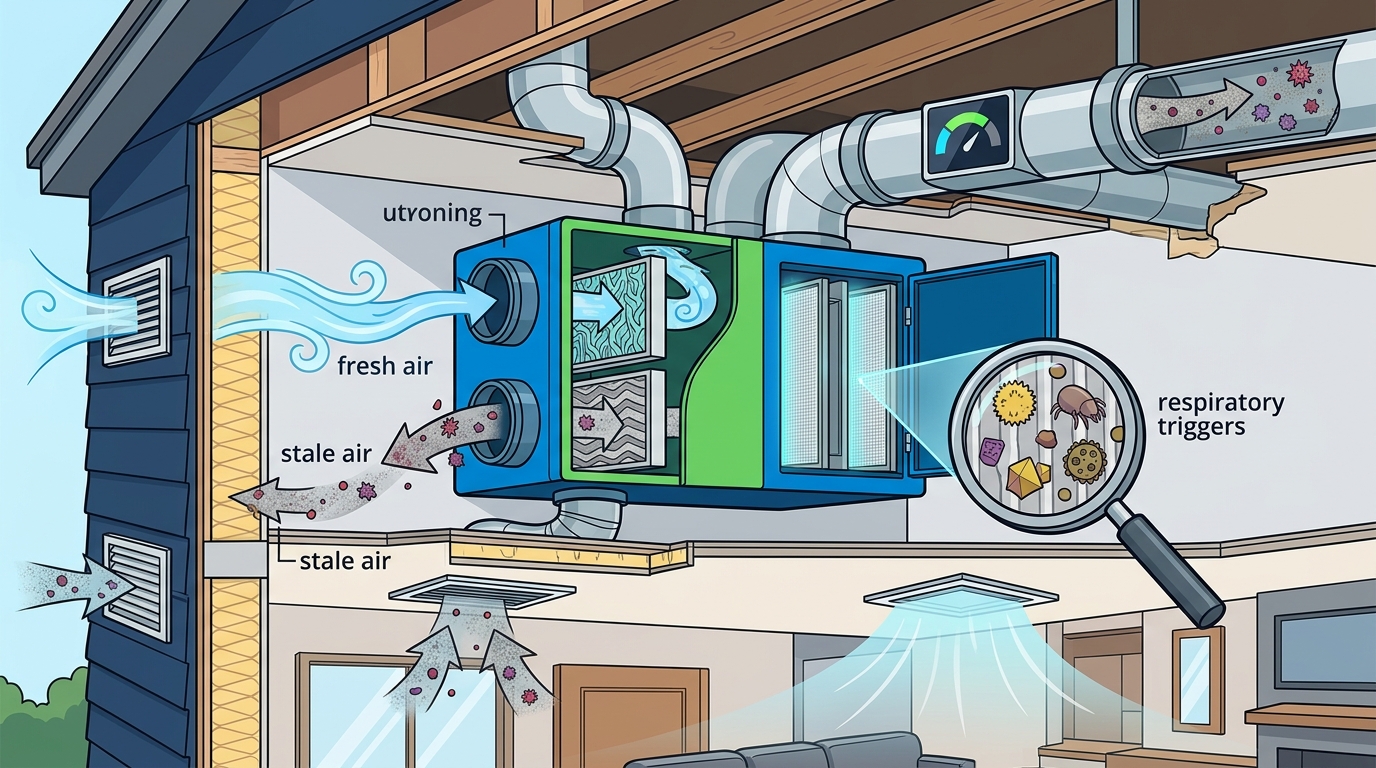
Understanding the mechanisms helps you take targeted action. Low ventilation rates harm respiratory health through several pathways:
- Pollutant accumulation: Cooking, cleaning, smoking, and off-gassing from furniture all release particulate matter and volatile organic compounds (VOCs). Without adequate air exchange, these pollutants concentrate indoors. One study showed each hour of gas stove use was associated with an 18 ppb increase in 24-hour NO₂ concentrations — levels that climb even higher in poorly ventilated homes.
- Moisture and mold growth: Inadequate ventilation leads to moisture buildup, which promotes mold, bacteria, and dust mite proliferation. These biological agents have been linked to asthma, chronic rhinosinusitis, hypersensitivity pneumonitis, and increased coughing and wheezing.
- CO₂ buildup: Exhaled carbon dioxide and VOCs alter indoor air quality, and the effect is compounded in overcrowded or poorly ventilated spaces. Research shows PM2.5 levels were 68 percent higher in high-density households compared with low-density households.
Children Face Elevated Risk
Children are disproportionately affected by indoor air quality because they spend up to 90 percent of their time indoors and their lungs are still developing. Research confirms that children living in poor-quality housing in England are more likely to report poorer health and experience worse respiratory outcomes. Critically, studies have also shown that either rehousing families or making modifications to improve ventilation, heating, and damp remediation results in measurable improvements in children's respiratory symptoms and quality of life.
Practical Strategies to Improve Home Ventilation
Here is a room-by-room and system-level action plan that balances fresh air intake with pollutant control:
1. Upgrade or Maintain Your HVAC System
Your central heating and cooling system is your primary tool for continuous air exchange. Ensure filters are changed on the manufacturer's recommended schedule, and consider upgrading to MERV 13 or higher-rated filters to capture smaller particles. Have the system professionally inspected annually to prevent it from becoming a source of contamination itself — research shows poorly maintained HVAC systems can actually increase symptom prevalence.
2. Use Spot Ventilation Where Pollutants Are Generated
Install or verify that range hoods vent to the outdoors rather than recirculating. Activate bathroom exhaust fans during and for at least 20 minutes after showers. In laundry rooms, make sure dryer vents are unobstructed and properly routed outside.
3. Leverage Natural Ventilation Strategically
When outdoor air quality is good and pollen counts are low, open windows on opposite sides of your home to create cross-ventilation. This is one of the simplest ways to flush indoor pollutants. However, check local air quality indexes before opening up — on high-pollution or high-pollen days, keep windows closed and rely on mechanical ventilation with filtration.
4. Control Humidity
Keep indoor relative humidity between 30 and 50 percent. Use dehumidifiers in basements and anywhere you notice condensation. Mold and dust mites thrive in humid environments, so humidity control is a ventilation multiplier for respiratory health.
5. Add Standalone Air Purifiers
In rooms with limited ventilation options, portable air purifiers with HEPA filters capture airborne allergens and fine particles. These devices complement — but do not replace — whole-home ventilation. Position them in bedrooms and living areas where occupants spend the most time.
6. Consider an Energy Recovery Ventilator (ERV)
For tightly sealed modern homes, an ERV brings in filtered fresh air while recovering energy from exhaust air. This addresses the trade-off between energy efficiency and healthy air exchange rates — a concern highlighted by research showing that green building practices that reduce air exchange may have uncharacterized health effects.
When to Call an Indoor Air Quality Professional
If recurring respiratory symptoms persist despite basic interventions, a professional indoor air quality assessment can identify hidden problems like concealed mold, duct contamination, or inadequate mechanical ventilation capacity. An HVAC specialist can perform a blower-door test to measure your home's actual air exchange rate and recommend targeted improvements.
At Apex Clean Air, we specialize in diagnosing and solving exactly these kinds of indoor air quality challenges — from duct cleaning and HVAC upgrades to whole-home ventilation design tailored to your climate and local outdoor air conditions.
Key Takeaways
- Research consistently shows a tendency toward improved respiratory health with adequate home ventilation, with symptom reductions ranging from 20 percent to several-fold in some studies.
- Low ventilation rates promote pollutant accumulation, moisture buildup, and biological growth — all established triggers for asthma, allergies, and respiratory infections.
- Ventilation must be balanced: in areas with high outdoor pollution, filtered mechanical ventilation is preferable to simply opening windows.
- Children and people with pre-existing respiratory conditions are the most vulnerable to poor indoor air quality.
- A combination of HVAC maintenance, spot exhaust ventilation, humidity control, and air purification offers the most comprehensive protection.
Frequently Asked Questions
Can opening windows really help with asthma symptoms?
Yes, when outdoor air quality is good. Natural ventilation flushes out accumulated indoor pollutants, VOCs, and excess moisture. However, on days with high pollen counts or elevated outdoor pollution, keep windows closed and use filtered mechanical ventilation instead.
What is a healthy air exchange rate for a home?
Research suggests that homes in cold climates should maintain a minimum air change rate of approximately 0.5 air changes per hour (ACH). ASHRAE Standard 62.2 provides region-specific guidelines for residential ventilation that account for home size and occupancy.
Does improving ventilation eliminate the need for air purifiers?
Not necessarily. Ventilation and air purification serve complementary roles. Ventilation dilutes and removes indoor pollutants with fresh air, while HEPA air purifiers capture fine particles and allergens that may still be present. For people with severe allergies or asthma, using both provides the best protection.
Can too much ventilation be harmful?
Yes. Research from the CHEER study found that excessively high air exchange rates in urban homes were associated with increased respiratory symptoms, likely due to higher infiltration of outdoor pollutants like PM2.5 and ozone. The goal is balanced, filtered ventilation — not simply maximum airflow.
How often should I replace HVAC filters to maintain good indoor air quality?
Standard 1-inch filters should be replaced every 30 to 90 days. Higher-efficiency filters (MERV 13 and above) may last up to six months depending on usage and local conditions. Homes with pets, smokers, or occupants with respiratory conditions should change filters more frequently.